Showing posts with label photograms. Show all posts

Tuesday, September 13, 2016

Some more Michael Jackson

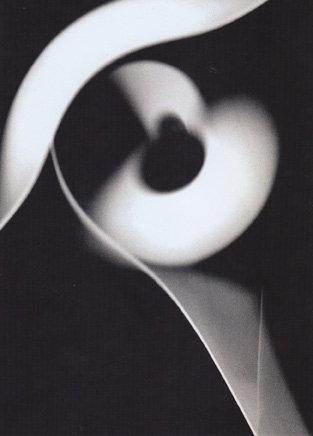
Jackson, #444, 2016

A year ago we introduced you to a fellow to watch named Michael Jackson.  We told you he was out in the UK's west country doing interesting things, photographing ripples in the sand, building paper constructions of mysterious hulking islands, and best of all, playing with light and shadow in the quiet of his darkroom.  He is a prolific artist, we even had trouble trying to calculate how many pieces he'd created - something like one per day was our best, not terribly well-informed, guess, a testimony to both the confidence he has gotten in his system of production and to his obstinate, unflagging energy and creativeness.  At anything near that rate a new Jackson show was a surefire necessity.  Earlier this summer London's MMX Gallery rose to the challenge and exhibited a batch of recent work.  It was a good moment to catch up with him to see how he's doing.

We're talking of course about that part of his output which he terms luminograms, as if to emphasize the primordial role of light in their making (another might call them photograms or skiagrams for similar reasons but let's not get into that discussion) and to distinguish them from the rest of his photographic corpus, which uses light as well, just not primordially.  A slip of theory underlies it: the idea that light, by bending and twisting and refracting, can so to speak show itself, that it can reveal to us something hidden about itself, its inner nature.  So there is a definite quest for knowledge, a search that will have no end because on this earth it seems we can never learn enough; and its waypoints must be intuited, as the knowledge to be found is more likely spiritual than scientific.   

This is very like Mike, his inquisitive frame of mind turning to awe in the face of natural phenomena: he is at home with the big questions and the small to the point of reverence - or innocence.  So that the record of his search becomes the work of art itself, the very pieces we have before us, at once both as documentation and object.  In this examination of his materials - light - Mike can be said to strike at the extreme end of modernism, along with painters like Jasper Johns, Robert Ryman, or Barnet Newman, each with their own quite disparate material obsessions in their day, or of photographers such as the under-recognized Jack Sal.  We can perhaps be grateful, however, in 2016, that his work is less austere than those, and far more sensuous, because the times have changed.  Here are some pieces from the MMX show.  There were 21 in all, each unique, 12 x 16 in. unframed, each of an uncanny beauty.

Jackson, #396, 2016
Jackson, #447, 2016


Jackson, #485 (Valley Landscape), 2016

Jackson, #524, 2016

In the year 1225, Robert Grosseteste wrote a treatise at Oxford in which he said that light extends matter by spreading itself infinitely in every direction and so forms material bodies.  It projects, it induces, it calls into being, it envelopes and continues on.  Mike understands this.  'In a certain sense,' Grosseteste wrote, 'each thing contains all other things.'  Mike gets that too.  He would have been a star pupil.

Jackson toying with light and shadow


Jackson in his studio


installation view at MMX Gallery

The discoveries he makes are not those of the great modern Swiss artists of the photogram, Humbert, Mächler and others, whose results were astounding and simple, astounding in fact because they were so simple.  Rather, he moves from the real world (but what is real about shadows?) to the fantastic and then back again, confusing the two, confounding us in the process and dragging a great deal of references with him, and much of his charm is that his path never fails to astonish.  Jackson is a magician.  Light beckons and he follows wherever it may lead.  'There are senses of reality [in my work],' says Jackson, 'but the rest is so fantastical that it could never be.'

For more information on his motives and methods, check out this video on YouTube produced by the gallery.  I'd like to say 'illuminating' but we're pun-free at the blog.

His website is www.mgjackson.co.uk


Tuesday, August 16, 2016

Mark-making in light and shadow

W.H. Fox Talbot, photogenic drawing, ca. 1839

W.H. Fox Talbot, paper delivered at The Royal Society, 1841

We've been ruminating about things - it's a slow month - and have begun to feel that our friends who work in cameraless photography come in two distinct species (exclusive of outliers from the heavily conceptual or apocalyptic strains).  First let's identify them, label them, and then let's try to make the labels go gently away.

We begin by plunging into the deep end.  So OK, there are folks who write on their working surface - let's call it a matrix - with a tool, be it stylus, pen, stick, or brush, and encourage these marks, through friction or abrasion, to define an expressive content.  This activity is similar to painting and is modeled after painting, no surprise here.  Most of the work shown in this blog is of this type, but not all by any means, and it is certainly not the only way to go as we'll see in a moment.

In this camp we find the chemigramists with their incisions, their clingy resists, and the glassprinters (cliché-verre artists) with their daubs and scratches, and not forgetting the brutalists (Marco Breuer comes to mind, or Brittany Nelson, along with many others emerging from the schools nowadays, where deconstruction is trendy) with their hammers, tongs, their strong mordants.  The matrix we're talking about may be the photographic paper itself, as in chemigrams, or it may be a glass plate, plexiglass, or acetate for the glassprinters, who will contact-print to achieve their end result.  Have I left anyone out?  I don't think so - they're all included here one way or another, and clearly there is a lot of cross fertilization among them.

Then there are the others, in many ways the more interesting group because their approach is so unexpected, and it is these we want to talk about today.  Instead of a brush or knife, they use that gratuitous, everpresent commodity we know as light.  Using just light and light's dark brother, shadow, they make a trace on photographic paper that is captured by the process of photographic development that we've discussed elsewhere (for instance here).  They have marked the paper, or matrix, but have touched nothing: the paper needn't be handled at all, since the visible part of the electromagnetic spectrum does all the work.  This is a very old tradition, which reaches back to the origins of photography and is in some respects its very definition.  Fox Talbot called it photogenic drawing, drawing arising from light.  Moholy-Nagy called it the photogram.  Other names have been used, schadograph, rayograph, vortograph, luminogram, skiagraph, light-painting, the list is endless.  When an artist sees how pain-free this procedure basically is, how miraculous, how magical, he is often so overcome that, ignorant of tradition, he names it after himself, or connects it to terms from a golden age of classicism.  He is unwilling to use the common expression because that word, degraded, cheapened, in the service of the most profane employments, has no common measure with the wonder he is seeing.  That word of course is 'photograph', drawing with light.

Alvin Langdon Coburn, Vortograph, 1917

László Moholy-Nagy, photogram, 1925
A few words and examples to get the feel of it.  In the darkroom, something is interposed between light source and the photosensitive paper.  An object, a hand.  Curled paper constructions, as with Francis Bruguière, or cut-outs as with Walead Beshty.  Gauze, as with Wolfgang Tillmans in his Freischwimmer series, which he calls 'abstract photos'.  Gobos, scrims, translucent things, lit by Fresnel lights, pen lights, candles, strobes.  Multiple exposures.  Or nothing at all, just the play of refraction and scattering of light-beams at an edge, or in movement, as in some of the work of René Mächler.  An exposure is made, the paper is developed.

Jaroslav Rössler, Akt, photogram, 1926

Francis Bruguière, Abstract Study, ca. 1926
Lotte Jacobi, photogenic drawing, ca. 1940
Arthur Siegel, Photogram #9, 1946
The work stands firmly in a relationship to the history of silver gelatin photography, to a compendium of darkroom practice, and could not exist without it.  It is reflexive, examining itself as both subject and object.  It acknowledges dependence on the physics of light as a wave phenomenon and on the physiology of the eye, much more so than other cameraless methods do, and it exploits these.  Thomas Young, in his famous 'double-slit' experiment of 1801, had demonstrated the refractive nature of light and both the constructive and destructive interference of waves.  His work is as much fundamental to the photogram journey as Talbot's.

double slip experiment


wave nature of light

When we peer today into the far recesses of pictures where light ends softly and shadow begins, at the roundness of objects, we thank him for helping us understand that.  We see it in Siegel or Jacobi, we see it wherever a reflective surface falls away into a vague smokiness, just as it starts to leave us.  Try these to get the idea.


Kilian Breier, Knicke, 1960-65

György Kepes, Feathery Light, photogram, ca. 1939-1940

René Mächler, Kollision, photogram, 1990

Thomas Ruff, phg.01, photogram, 2012

Fox Talbot, in a journal entry of 1833, wondered if a way might be found to make pictures of things without having to go to the trouble of drawing them, for he was, by his own admission, a terrible drawer.  He was vacationing in Italy near Lake Como and wanted to record impressions of mountains, ruins, old villages.  He set his mind to it and after a few years his attempts at sensitizing paper with silver salts succeeded: you put the paper in the sun with something above, a leaf, a bit of lace, and you get the example at the top of this post.  He called it photogenic drawing.  You couldn't exactly take pictures of mountains with it, the paper wasn't yet sensitive enough, but it was a start.  Sir John Herschel, always more clever than anyone else around (who would shortly announce his discovery that certain salts of sodium could fix, or stabilize, photographs, opening the way for an entire industry to flourish later in the century) immediately devised the word 'photograph' from photos = light and graphein = write, draw, to describe what was happening.  If photography had stopped right there, everyone might be making photograms today.

But it was not to be. The camera obscura, a box that had earned its keep for a thousand years from China to Baghdad to medieval Europe as an intellectual curiosity for the focusing of light rays, was given a new assignment.  Hooked up to the photogram, it came to usurp and far exceed the photogram's function.  The genie was out of the bottle.  Photography was now pointed away from itself - more 'usefully' one might say - out into a world of people, plants, and objects.  Photography had left the shop, taken its notes, and the only ones behind were the men and women whose works you see above.

Accept it or not, this is understood to be how it has been.  Photography is now the province of everyone.  Yet we notice a curious thing: people - artists and amateurs alike - are beginning to turn back to the old methodologies, pausing to examine the beauties left along the path of our adventure - there are so many! - and to reinvent them, remake them in new ways for a new age.  Not in droves just yet, but that will come.  It is a good time then for all of us to rejoin the family of photography, to embrace and reclaim its name and put aside the squabbles of process and ownership, of territory and priority, that have plagued us from the beginning.  We draw with light.

This past summer, a gallery in Germany invited a chemigramist to submit a picture to a group show of experimental work.  He sent them a chemigram.  On the wall it was labeled 'photograph, silver gelatin print.'  No mention of chemigram, skiagraph, bamboozlegraph, nothing.  There is much more that joins us than divides us and I say bravo to that artist and that gallery.  Our words do matter, and our allegiance.


Wednesday, November 4, 2015

The end of the photogram: Roger Humbert

Humbert, IMG_2699. 01.10.2013, 2013

When you first see a picture by Roger Humbert, you know you're in the presence of an artist unlike any other who has dealt with light.  It is a medium he has made his own (as if he had the authority to do so), along with its consorting twin, shadow.  Each defines the other, whiteness and darkness, energy and its absence.  His mind runs over the wavelengths of its spectrum as a pianist's fingers run over the keys.  It's both immanent and elusive, and he thinks about it all the time.

Humbert, IMG_2764. 01.10.2013, 2013

Much has been written of his connection in the early 1960s with the movement known as Concrete Photography, which promoted the idea that a certain minimalism had a philosophic content, or perhaps the other way around, that phenomenological currents in intellectual circles led to a reductive photography.  Influenced in any event by the writings of Max Bense and the graphic work of Swiss compatriot Max Bill (all these Maxes in the service of minimalism!) it found its roots ultimately, going back further, in the Bauhaus teachings of Laszlo Moholy-Nagy and before him to Coburn.  We touched on that in an earlier post last year.

That agenda - and the work of the four or five artists gathered at the time for ground-breaking shows in Basel, Bern and Zurich - seems at this juncture, in my opinion, to have been little more than a pretext for critical ponderousness or puffery for a sales pitch to an uncomprehending public.  Addressing those critics, it's not helpful or insightful to claim that photography was becoming self-referential, gazing at the processes that undergird it.  That comes off as obvious, but only because those making the work had driven themselves to do it: it was not necessarily in the plan.

Humbert, IMG_1429. 15.12.2011, 2011

Humbert, IMG_1960. 20.04.2012, 2012
Humbert, IMG_1160. 03.11.2013, 2013

And still, the record shows Humbert preceding the movement by a decade and surviving it happily for many more, no thanks to the commentariat.  He is the real deal, and he is still producing the work.  His is not a postured minimalism but rather one informed by a passion to understand - and, if not understanding fully, for who can, then to depict at least what light really is for us or may be, this thing that is not object but event, surface, density, and more.

Mächler, Sechs quer strahlend, 1971
Even his great countryman and contemporary, the late René Mächler, was not able, in the end, after many years, to approach the mysteries of light with the sensitivity of Humbert.

It all began in the darkroom in the late 1940s, with an enlarger and a tray of photographic chemicals.  Using stencils he would cut out and computer punch cards, a relic most readers of today have never seen, he created photograms.  Then he would move light around to make luminograms.  He used all the methods others have used to explore light (Matter, Jacobi, Arthur Siegel) but without the theatrics or the sentimentality.  Some would say he has paid the price but he would just give us that wan enigmatic smile of his and say he has only gained by it.

Humbert, untitled, 1955

Today he has transitioned to digital in keeping with the times, but here are some earlier works, all analog, now housed in the Fotostiftung Schweiz.  Notice how much the energy in these earlier pictures was made explicit through rapid gestural shifts and the layering of photographic material, whereas now, to imply this energy, all he has to do is massage the depth of field and the bokeh, and use the reductive tension set up by nuanced pools of darkness.  Humbert is a master of this and his recognition is growing.  Photo Edition Berlin recently hosted a solo show of his latest work and published a catalog from which some of these images are taken: you should go out and get it.

Humbert, untitled, 1968

On YouTube, in a conversation with Gunther Dietrich, he recently said he's approaching the end of photograms and of his life-long study of light, that there's nothing more to be done.  From this it's evident that each picture for him is more than just a picture, or less than one: it's an exploration, a journey.  His work is as much science as art.  There is no need to revisit where he has gone before, he has already shown us what is there.


Roger Humbert, 2015


Thursday, June 10, 2010

Welcome to nonfigurative photo

This blog will talk about things, events, people, images, processes, and ideas connected in some way to the art of nonfigurative photography, especially as this art is being practiced today in its many forms, both in the US and around the world.

It will be inclusive rather than exclusive: we encourage news and discussion of approaches that might range from photograms to chemigrams to luminograms and points in-between or beyond. While many posts will likely relate to cameraless work, other kinds of abstract photography will find a place here too, if they seem to us concerned about inventing a reality rather than commenting on or representing one. This theme will be developed in time.

And when there's nothing left to say, I'll comment or muse on some of the technical problems I encounter in my own work.

Meanwhile, welcome to the nonfigurativephoto blog!

Douglas Collins