Showing posts with label Photo Edition Berlin. Show all posts

Wednesday, November 4, 2015

The end of the photogram: Roger Humbert

Humbert, IMG_2699. 01.10.2013, 2013

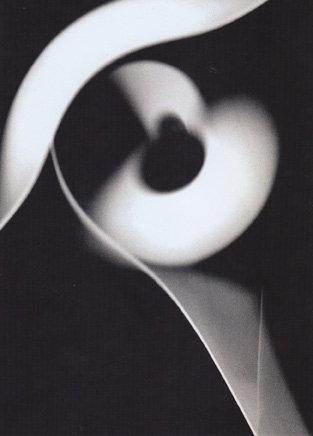
When you first see a picture by Roger Humbert, you know you're in the presence of an artist unlike any other who has dealt with light.  It is a medium he has made his own (as if he had the authority to do so), along with its consorting twin, shadow.  Each defines the other, whiteness and darkness, energy and its absence.  His mind runs over the wavelengths of its spectrum as a pianist's fingers run over the keys.  It's both immanent and elusive, and he thinks about it all the time.

Humbert, IMG_2764. 01.10.2013, 2013

Much has been written of his connection in the early 1960s with the movement known as Concrete Photography, which promoted the idea that a certain minimalism had a philosophic content, or perhaps the other way around, that phenomenological currents in intellectual circles led to a reductive photography.  Influenced in any event by the writings of Max Bense and the graphic work of Swiss compatriot Max Bill (all these Maxes in the service of minimalism!) it found its roots ultimately, going back further, in the Bauhaus teachings of Laszlo Moholy-Nagy and before him to Coburn.  We touched on that in an earlier post last year.

That agenda - and the work of the four or five artists gathered at the time for ground-breaking shows in Basel, Bern and Zurich - seems at this juncture, in my opinion, to have been little more than a pretext for critical ponderousness or puffery for a sales pitch to an uncomprehending public.  Addressing those critics, it's not helpful or insightful to claim that photography was becoming self-referential, gazing at the processes that undergird it.  That comes off as obvious, but only because those making the work had driven themselves to do it: it was not necessarily in the plan.

Humbert, IMG_1429. 15.12.2011, 2011

Humbert, IMG_1960. 20.04.2012, 2012
Humbert, IMG_1160. 03.11.2013, 2013

And still, the record shows Humbert preceding the movement by a decade and surviving it happily for many more, no thanks to the commentariat.  He is the real deal, and he is still producing the work.  His is not a postured minimalism but rather one informed by a passion to understand - and, if not understanding fully, for who can, then to depict at least what light really is for us or may be, this thing that is not object but event, surface, density, and more.

Mächler, Sechs quer strahlend, 1971
Even his great countryman and contemporary, the late René Mächler, was not able, in the end, after many years, to approach the mysteries of light with the sensitivity of Humbert.

It all began in the darkroom in the late 1940s, with an enlarger and a tray of photographic chemicals.  Using stencils he would cut out and computer punch cards, a relic most readers of today have never seen, he created photograms.  Then he would move light around to make luminograms.  He used all the methods others have used to explore light (Matter, Jacobi, Arthur Siegel) but without the theatrics or the sentimentality.  Some would say he has paid the price but he would just give us that wan enigmatic smile of his and say he has only gained by it.

Humbert, untitled, 1955

Today he has transitioned to digital in keeping with the times, but here are some earlier works, all analog, now housed in the Fotostiftung Schweiz.  Notice how much the energy in these earlier pictures was made explicit through rapid gestural shifts and the layering of photographic material, whereas now, to imply this energy, all he has to do is massage the depth of field and the bokeh, and use the reductive tension set up by nuanced pools of darkness.  Humbert is a master of this and his recognition is growing.  Photo Edition Berlin recently hosted a solo show of his latest work and published a catalog from which some of these images are taken: you should go out and get it.

Humbert, untitled, 1968

On YouTube, in a conversation with Gunther Dietrich, he recently said he's approaching the end of photograms and of his life-long study of light, that there's nothing more to be done.  From this it's evident that each picture for him is more than just a picture, or less than one: it's an exploration, a journey.  His work is as much science as art.  There is no need to revisit where he has gone before, he has already shown us what is there.


Roger Humbert, 2015


Friday, November 14, 2014

Gottfried Jäger at Photo Edition Berlin


Jäger, Fotopapierarbeit 1986-VI-1-3, 1986

In photography, the 1960s was a period of considerable excitement, uncertainty, and turmoil.  The achievements of the great experimental work of the Bauhaus, both German and its later incarnation in Chicago, were behind us, even if its aesthetic and methods were not fully absorbed by a wider public.  Scientific uses of photography began to tantalize with big steps forward in photomicroscopy and electron microscopy.  The advent of digital was on the horizon, nascent but inexorable.  Color photography was emerging and becoming an attractive, and soon a required, addition to black-and-white.  In painting and sculpture, abstraction of one kind or another was the ruling mode.  For certain photographers, there was a growing dissatisfaction with the dominant ethos of representational photography, of pictures that sought simply to capture and reproduce what was seen by the lens.  They had the radical vision of a photography that was about nothing but itself, not the messiness and the contingency of the external world.  They called for Fox Talbot's 'photogenic drawing' but for a new age.  They wanted to create, not re-create.  They debated what it even meant to be a photograph, that stubborn physical object composed of animal protein, silver salts, and light.

Jäger, 111104.4, 2011

Into this mix came a young artist and theoretician named Gottfried Jäger who, in a series of group shows beginning in 1968, crystallized and formalized this restlessness into an agenda, or more accurately several agendas, with robust-sounding names like Concrete Photography and Generative Photography.
Jäger, Fotopapierarbeit 2011-III-1-2, 2011

In reaching back to the antecedants of concrete photography, Jäger found a forerunner in Alvin Langdon Coburn, the early British abstractionist and disciple of Ezra Pound; another touchstone was Laszlo Moholy-Nagy, who had preached the primacy of the emulsion as the ultimate locus of photographic expressivity.
Coburn, 1917

The name for his movement though not the doctrine as a whole came from Theo van Doesburg's 1929 manifesto on Concrete Art, which followed the De Stijl movement and the thinking of Mondrian.  Mondrian liked straight parallel lines and primary colors and more than anything, precision.  (For a while van Doesburg and Mondrian clashed over diagonals and broke off relations for several years).

Time has been kind to us and Jäger's turn of the concept was more tolerant: it embraced a broad spectrum of non-objective photography from computer-driven images (the term Generative Photography stems largely from this) to entirely cameraless work using chemical action operating at the emulsion surface; even strange apparatus had a place in his system, from oscilloscopes (Franke) to light-filtering contraptions (Humbert) to pinhole cameras (Jäger himself, early on).
                                       
Moholy-Nagy, 1922
What was important - what remains important - is the idea that you can create or discover a new reality of space and time just by rethinking the most minimal elements of photography, the physics and physicality of it and its optics.  It is this search for a crossing-over, a transmigration mediated by process and technique, that shapes the Jäger aesthetic in order to finally become one with it: ostensible 'beauty' is not a critical category here at all.  In this it is consummately postmodern.

Photo Edition Berlin has embarked on the staging of a two-part exhibition entitled 'Concrete and Generative Photography 1960-2014' which is meant both as an homage to what Gottfried Jäger was instrumental in launching as well, perhaps, as an announcement of future work to be done.  Part One - The Pioneers, runs until December 20, 2014, and includes many of the original posse: Heinz Hajek-Halke, Herbert W. Franke, Pierre Cordier & Gundi Falk, Roger Humbert, Hein Gravenhorst, Karl-Martin Holzhäuser, René Mächler, Gottfried Jäger.  Part Two, with a contemporary and possibly more international cast, will arrive in the fall of 2015.

at the opening, October 18
You can download a pdf file of the informative 46-page catalog at the Photo Edition Berlin site.  For a thorough account of the history, concepts and methods of a large roster of experimental and non-objective artists, consult Jäger's Bildgebende Fotografie (Köln 1988).  The Folkwang Museum online is an excellent source of images.