Showing posts with label Martha Casanave. Show all posts

Friday, October 27, 2017

Those painted photographs

Woman in overcoat, photobooth snapshot, anonymous hand-coloring, ca 1950, private collection

It's irresistible, the desire to touch the surface of a photo with brush or pen and thereby change it into something more expressive.  Often this involves color, whether adding color to a color photo (which is not the same as bringing coals to Newcastle) or adding it to a black and white photo, but it doesn't have to.  You may remember a rather delirious post from a few years ago on zombie prints and Lazarus prints (yes, they exist), on bringing prints back to life when you thought they were hopelessly dead.  Most of the artistic interventions shown there involved using marker pens to scribble a few lines to highlight or obliterate a figure, or to make a comment, ironic or slyly humorous.  Many of those lines were black or white as though in homage to the chemistry, but color works just as well - if not better.  Today we're going to look at a few ways color has been exploited to further enhance photos in a variety of artistic practices in recent years, and from this it is hoped the reader may discover ideas that he or she can use in their own work.

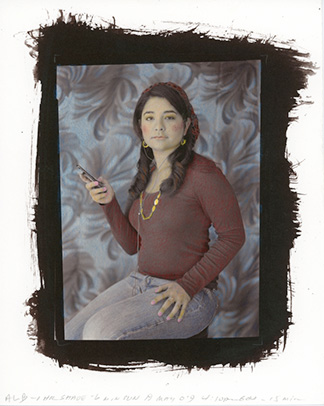
Martha Casanave, Girl with device, albumen print, hand-colored, 2009-2016

Not everyone is aware that coloring a photograph, or hand-coloring as it is commonly called (or hand-tinting), is as old as photography itself.  To render the earliest portraits more realistic (always thought to be a good thing) hand-coloring appeared in the 1830s practically with the invention of photography, and soon wealthy clients had their private colorist on call, a matter in their milieu of some prestige.  Methods employed by the colorists varied according to substrate, as photographic technology passed in rather short order from metal plates (daguerrotypes, tintypes) to glass plates (wet plate collodion) and finally to paper - I'm sure I'm skipping a step or two. Often a varnish or other medium was applied to the surface beforehand to insure an even adhesion, and water colors, oils, dyes, pastels each had their devotees as the main colorant vehicle.  The many manuals written on these efforts are still worth the while to peruse for the serious student of hand-coloring and can be found on the internet.

Luis Vasquez, postcard, hand-colored, ca 1940, private collection

Yet these developments were not without their detractors in the serious photographic community: many artists saw in hand-coloring a corruption of the pure photographic tones of the emulsion, regarded as sacrosanct - although hypocritically they didn't seem to mind retouching a photo here and there with drops of inks and dyes where necessary.  In any event, their fears receded when Kodak introduced the first widely available color film, Kodachrome, in 1935, and demand for hand-coloring slid into gradual decline, becoming no longer commercially viable by 1950 except within certain traditions, like the flamboyant hand-painted postcards from the workshop of Luis Vasquez in Mexico.  Traditional hand-coloring, meaning a practice perpetuating the aims, concerns and methods of the earlier era, and often but not exclusively based on the use of Marshall's Photo Oils, a staple of the trade, has today become a niche artisanal activity with its own distinct rewards and pleasures, though perhaps limited in reach.  An excellent example of what can be achieved is seen in some of Martha Casanave's work.

So from the sixties onward artistic intentions in the use of color shifted, with acrylics and gouache beginning to assume a more prominent role; this is especially seen in work where overpainting to the edge of opacity is more crucial than simple tinting.  The painted photographs that Saul Leiter executed for his private amusement in the closing decades of the twentieth century, after making a name for himself both in fashion and in street photography, are a case in point.  In their lyricism and utter abandon, Leiter has taken the notion of painted photographs to a culmination, so much so that the underlying photograph just nominally provides the support and occasion but otherwise is hardly visible.


Saul Leiter, ca. 1990


Saul Leiter, ca 1990

Saul Leiter, ca 1990

This leads us to think about other strategies for hand-coloring, if we can be bold enough to group widely disparate approaches under a common heading.  We must step back for a moment.  At the beginning there was the classic mode of an informed realism, filling in for the poverty of monochrome photography and using materials meant not to cover up but to enliven that photography.  It is true that this later became exaggerated at times to the level of kitsch (see Woman in overcoat), but that is not to diminish its accomplishments, for out if it came a body of methods of extreme subtlety and finesse; some of this heritage is alive and well today and put to high artistic purpose - go back and review Casanave's picture Wave Machine where only the starfish gets hand-colored, the other details having glanced off into a suspicious tangle of background.

William Klein, ca 1960-1990

William Klein's aggressive daubs over contact sheets from the 1960s is a result of a different meditation, one that looks back into drawers of old prints after years and disavows or re-embraces their attitude across the gap in time with a sort of schoolboy graphism, one that prefigures Lazarus prints and confers a revivified existence while sidestepping responsibilities of ownership.

William Klein, ca 1960-1990

At another extreme is the work of Anselm Kiefer, especially that part of it set in a timeless ether of intellectual history and unfulfilled promise, where multiple shades of grey invoke a retreating but ever-present past.  Here graphite and gouachy layers over photographs of uncertain provenance serve up the general mood; in the best of his pictures the effect is disturbing.

Anselm Kiefer, Leonardo Pisano, liber quadratorum, 2008
Anselm Kiefer, Sefiroth, 2002

Though not limited to photo-based work, one of the benefits of working with photos is that you can reprint them endlessly in trying out different painted looks or ways to proceed before you have to commit.  Kim Weston in recent years has turned to overpainting his photos of models and dancers, where the method seems well suited to that theatricalized world.  Here, in a talk in Carmel, he demonstrates how he can dress and re-dress his models at will, from a given photograph, to gauge the effect.

Kim Weston, from a talk in Carmel June 30, 2012

So a photograph is more than a picture, it is an opportunity, an open invitation.  When poet and singer Todd Colby was gifted with a trove of photographer's calling-cards from the pre-WWI era, he did the natural thing, he painted them.  Here are two:

Todd Colby, hand-colored vintage calling-card, 2017

Todd Colby, hand-colored vintage calling-card, 2017
These are extraordinary in their simplicity, and show how the artist's hand can change the prosaic into something quite dramatic, bizarre, and (maybe) beautiful.  Go Todd!

To close this post let me point out what should be obvious: that hand-coloring is not limited to the subjects of the real world.  In my own work of cameraless photography, untethered as it is to anything we usually call real, I find moments when I have an overwhelming inclination to smear on some paint, just to see what it does.


Douglas Collins, etched chemigram with hand-coloring, 2016

A philosopher once said a picture can be a picture of anything, if you expand the concept of picture sufficiently.  Or maybe Todd Colby said it.


Sunday, January 22, 2017

Martha's tears, on view in Arizona

Casanave, Anatomy of a Tear, No. 932. 2016

Martha Casanave has been a friend and colleague for many years and today occupies a distinguished place in the community of the cameraless.  What we didn't know about her was that some while ago she had conceived a most peculiar and private project: she'd been collecting her own tears in little vials, day in and day out, and storing them on microscope slides.  No one knew!  Nor can we even begin to guess at the cause of these tears, whether grief, sorrow, loneliness, disappointment, the lightness of being, existential joy - or all of that and possibly more, thrown in together.  According to those who know her best, never over this period did she make any outward display of heightened agitation or exaltation, bereavement or crush: nothing worthy of a tear.  If we'd known of her true state, we might have considered intervening.  In public she has always seemed fairly normal and unruffled - outspoken, yes, but that's no reason for choking up.  Yet here we are.  Her private life was deeper that we thought.

the artist collects a tear

Happily for us, she recently chose to shed the veil of secrecy and offer her tears to the world.  She has printed a selection of them, using a special microscope devised by her friend Chris, an equipment guru, and are on display at Art Intersection outside Phoenix until February 25, within a larger show called Independent Presence that features current work by a band of woman photographers from Monterey, California.  With a nod to the pioneers of microphotography of the Victorian Age - several of them it turns out were women - Martha's contribution is entitled Explorations through a Fabricated Microscope: A Compendium of Tears.

In looking at these beautiful images, we tread carefully: we feel we are somehow going where we are not allowed, but we can't help ourselves, we are powerless, we are drawn in.  It feels a bit obscene.  And yet there is a curious properness to everything too, a modesty, a primness, even though she is baring intimate recesses of her soul.  Very nineteenth century you could say.  She'll reply by telling you that's her favorite place in time because that's when photography was invented : it's her crowd.

Casanave, Anatomy of a Tear, No. 1012, 2016
  
A whiff of victoriana in fact is everywhere in the presentation: in the vignetting of the images, in the cursive script of the identifications, adding further to the charm.  Has she decorated her work in this way to distance herself from the intensity of the emotions behind the tears, enabling her at last to go public with them?  We cannot say, but it's plausible.  The separation in time to the present from underlying events can be seen as an additional buffer.  Despite this, she reports that in finally printing them last year, after so long a wait, the emotions often came flooding back and the experience of doing it was stressful and upsetting in the extreme.

Casanave, Anatomy of a Tear, No. 908, 2016

Casanave, Anatomy of a Tear, No. 1005. 2016

Casanave, Anatomy of a Tear, No. 980. 2016

Casanave, Anatomy of a Tear, No. 957. 2016

Casanave, Anatomy of a Tear, No. 942. 2016


For the poets, the tear has long held a special position as poetic object, helped by its pearl shape and its unexpected appearance in the eye of the beloved.  John Donne, writing in 1601 in A Valediction: Of Weeping to the lady he would marry, gets right into it: 'Let me pour forth my tears before thy face.'  Tears are as metaphors for the round globe of the earth, everything is reflected in their concave surface - you, your face, your world, and my tears are a part of you because they come from you, as yours do from me; and when they join, 'heaven is dissolved'.  Tears lead to a rapturous dissolution, all tears do.  You stagger, you have grown suddenly weak, you fall down, but in bliss.

When Martha was asked which tears she found the most beautiful she said the saddest ones.  She didn't hesitate.

Of her books, Explorations along an Imaginary Coastline (2006) is the one closest in feeling to this new work, and should be added to your collection. 


Tuesday, February 24, 2015

A look into Martha Casanave's world

Casanave, untitled, 2012
Martha's been using a camera for fifty years - for teaching, for portraiture, for staged photography, for essays on artists and writers of the former Soviet Union, the list goes on.  Another equally important part of her work during this period has involved specialized cameras: pinholes, large format cameras, nineteenth century contraptions, wherever her heart directs her.  To my mind Martha's finest book remains the amazing pinhole odyssey entitled Explorations Along an Imaginary Coastline, which is essential reading. 

But at times she dispenses with the camera altogether and creates pictures which readers of this blog are familiar with, if not practitioners themselves: lumens, glassprints (Martha sticks by the term cliché-verre and we'll follow her on this), and chemigrams.  Today we want to look at a group of her cliché-verres from 2012, but first we must set the stage.

Casanave, untitled, 2012

Casanave, untitled, 2012
Let's step back and see how we got here.  W. H. Fox Talbot, around 1835, made a few drawings by setting botanical materials on glass plates.  He wanted to see if he could print these images onto paper sensitized with a coating of silver salts.  He could.  Since sunlight was the driving force, he called them 'photogenic drawings' or drawings arising from light.  A few months after he got around to announcing this feat, in 1839, three Englishmen, apparently etchers or engravers, applied for a patent on a process to make a 'glass print' by drawing with etching needles on sooted glass and printing it on sensitized paper.  It was an improvement on Talbot and a legal tussle may have ensued over the rights, we don't know for sure.  What we do know is that the process was never commercialized, and quietly died.  The three Englishmen returned to their etching.

Across the Channel, a Frenchman by the name of Adalbert Cuvelier, an amateur painter and skilled photographer (photography was booming by the 1850s), invented basically the same process in 1853 and called it cliché-verre (who knew it was a zombie process?)  He lived in a rural area and had a friend nearby who was a painter too and loved to paint landscapes.  His name was Jean-Baptiste-Camille Corot.  Corot wanted to learn this new technology, seeing in it a way to do quick sketches from nature which later could be printed, then recast as paintings: a transfer process basically.  Cuvelier was happy to show it to him, and he showed it as well to Corot's circle of painter and printmaker friends - Millet, Delacroix, Rousseau and others - who had begun leaving Paris for the more aesthetically pleasing countryside and forests of Barbizon, south of Arras where Cuvelier lived.  Soon the forests were teeming with artists carrying around sooted glass plates, scouting for scenic views, idyllic streams, stoic peasants.  We are in the heyday of cliché-verre, roughly from 1860 to 1875.  Incredibly, many of these glass plates survive today and can still be contact-printed.
Corot, Souvenir d'Ostie, cliché-verre, 1855


Casanave, untitled, 2012
A rapid succession of technological breakthroughs brought this period to a close, along with possibly - we speculate - a certain ennui of the forests and a yearning for the café life of Paris.  First, gelatin dry-plate photography was invented in 1871 to supplant the older, cumbersome, wet-plate process; George Eastman established a company to exploit it, and it now became much easier to photograph a landscape instead of painstakingly drawing it on a plate.  Cameras themselves became smaller, cheaper and simpler.  Eastman introduced photographic film, and in 1888 a small portable camera, the Kodak; a more revolutionary technology for the general public was not seen until Steve Jobs' iPhone more than a century later.  Cliché-verres by now, amazingly, were soon a relic.

Casanave, untitled, 2012
For the next hundred years and merging with our times, most of the history of cliché-verre has been one of scarcely more than flirtation and curiosity, associated occasionally with hot-button names like Klee, Picasso, Man Ray etc, but with no enduring commitment from anyone.  Each dabbled, did one or two, and moved on.  Roland Barthes discusses some of the reasons in his book The Neutral: Lecture Course at the Collège de France (1977-78) but I warn you if you go there it's buried deeply.  However, as in all things there are exceptions.  I have my favorites among the modern or modernish cliché-verre artists and I return to their work often: I find it passionate and overlooked.  The list must include Hajek-Halke and Chargesheimer in postwar Germany and Aris Koutroulis and Abelardo Morell in America, the latter two both discussed elsewhere on this blog.  (Two other Americans often cited, Henry Holmes Smith and Frederick Sommer, I will pass over in strict silence.)

And then there is Martha Casanave.

What moving, mysterious, wonderful pictures these are.  They wake you up, you who've been sleepwalking through the galleries of contemporary photography.  They lie well beyond representation, even beyond structure, but not beyond poetry.  They are calm, profound, and intricately rational like a microscope slide of a human cell, but a cell no one has ever seen before.  How does she manage to pull it off?

She switches from poetry to prose to help us understand.  "I smoke pieces of glass with a candle.  You can do varying densities of smoke, and varying shapes, depending on how you hold the glass.  Then I drop alcohol on it.  I sometimes use just water.  No predicting how it will look of course.  If I don't like it, I just wash it off and start again.  I don't save any of these 'negatives'.  I make 8x10" prints in the darkroom.  I scan some, and make big digital prints."

Casanave, untitled, 2012
Corot would have understood her, if you take out the digital.  The two of them could have smoked their glass over the same candle.

Her website is www.marthacasanave.com


Saturday, April 12, 2014

Naming wildflowers in the desert

Casanave, Wave Machine, Monterey Bay Aquarium, 2013

(A guest post by Bobby Bashir)

When my boyfriend Chris suggested we drive down to Arizona to look at the wildflowers I said why not and we began planning it right away.  I don't know why I hadn't thought of it first.  But Chris does whims very well, that's one thing (there are others) I love about him.  It was February after all and in a few weeks we knew the first yellow blooms of brittlebush would dot the high deserts and mountains east of Phoenix, sending all who hiked up there into transports of joy or at least disbelief.  We exchanged a brief kiss to seal the deal and decided that's something we wanted to be a part of.

Bashir, Near Apache Junction, Arizona

I called Omar - could he cover for me at the restaurant?  No problem.  Next I had to tune up the old van with new belts and brakes for the 10 hour drive ahead, then freshen up the living space in back and I don't just mean redecorate although that too - we had found some royal blue Ralph Lauren floral patterns and I had a few notions about how to use them.  Then we put in new supports, not springs exactly but what you could call a distant relative of the spring, under the saggy bed, cleaned the espresso machine and test-ran our slow-cook oven - my big contribution from a trip last year to Bodega Bay - on a bulging chicken tamale I confected for the purpose.  It worked.  By Saturday everything was ready and we headed out.

I let Chris drive and we followed the old pony express trail known as Interstate 10 till we got to the Arizona border.  He's tireless behind the wheel, I really admire him for that.  Too talkative maybe, depending on your mood and whether you want to hear the same crazy stories again, true they're a little different each time, a new inflection here, a new character there, but it gave me time to figure out where we might want to go once we reached what they call the East Valley around Scottsdale and Mesa.  It was then I noticed that Art Intersection in Gilbert was about to open a show of alt-photography called Light Sensitive 2014.  I scanned the entries online and recognized several names.  Hey, we could drop in, it's just down the road from Mesa.  Chris was a fan of my lumen prints so he thought it'd be fun to check it out too.

Darkness was falling when we found the gallery.  The opening was in progress upstairs, lights blazed and you could see figures moving about at the windows, but I for one was pretty tired and hungry (I'd taken over the wheel after crossing the Colorado River) so we said let's eat before we go up.  On the ground floor was a place called the Euro Cafe that looked active.  We got a table and I ordered the spanaki balls (spinach, rice, mozzarrela and provolone), an overwhelming portion that I shouldn't have gone for, medically speaking, while Chris had the pork molise, grilled pork wrapped in bacon topped with an apricot & cherry sauce, alongside horseradish mashed potatoes.  We staggered out, leaning and bumping into each other, well fed but already nostalgic for the delicate wonders of California seafood.  Could we survive in Arizona?
Bashir, Art Intersection by daylight, Gilbert, Arizona
Bashir, At the opening

Yes, as it turned out.  The gallery was more spacious and attractive than we'd thought, and the pictures handsomely lit and hung.  The attendees, probably locals from their weathered tans, seemed unexpectedly alert and knowledgeable about the niche interests of 19th century hand-crafted analog photographic art, if we properly judged their somber nods and whispers.  We circulated.  There was considerable mystery on the walls and, often, beauty as well.  You had gum bichromates, bromoils, ziatypes, tintypes, argyrotypes, platinum palladium prints, a few chemigrams and pinholes and even a lumen if I'm not mistaken.  Have I missed anything?  No mordançages this year, sorry Brittany.  Chris's favorite was Martha Casanave's low-angle pinhole with very selective hand coloring called Wave Machine, which recalls the dreamy theatricality of her great book, Explorations Along An Imaginary Coastline, still available from Amazon and which everyone should rush out and get.  The critics haven't yet come close to doing justice to Martha's work; she awaits her ideal interpreter.  But I predict her day will come.

My own salute goes to Douglas Collins' strange, and strangely funny, untitled piece, a chemigram.  Don't ask me what it 'means,' but I'm told there's no story behind it, no allusions.  It is what it is as they say.  Later Chris and I, up in the Tonto National Forest north of Apache Junction, spent a whole evening talking about it, reaching no agreement whatsoever, and then going off in tangents from it after our third bottle of wine.  That's what alt-photo art can do to you.

Collins, untitled, 2013

Bashir, A creosote bush

So this post has become more about the art in Gilbert than the wildflowers we came all this way to see.  Let me show you some pictures to prove how wrong you are.  Did you know that cacti have flowers?  I like to taste their flowers too, I keep them in my shirt pocket and nibble on them as I ramble and roam.  There were also lupines (mementos of home!) just coming up, and desert marigolds, and here and there a creosote bush, lots of yellow, yes, you have to wait later in the season for more of the blues and whites like peppergrass, one of my personal treats.  Chris thinks I'm nuts.  Let him say that.  Another time I'll tell you about his problems.

Luckily we didn't meet up with any scorpions but that's not what you think of when you're having fun. 


Bashir, Somewhere in the Superstition Mountains

Bashir, Near Pinnacle Peak


Bobby Bashir
Seaside, California
www.bobbybashir.com


Thursday, August 23, 2012

Cameraless at Cabrillo

Sieglinde Van Damme, 2012
Is there a resurgence of cameraless photography these days, or is that just my imagination?  If I didn't know better I'd say there was.  You saw it during the recent f295-sponsored alt-photography conference in Pittsburgh, where Norm Sarachek's spirited keynote address, to a packed audience in the august halls of the Carnegie Museum of Art, was on chemigrams.  Who can remember when chemigrams last received so much attention?  Later, in several of the more popular workshops such as Elizabeth Opalenick's on mordançage, the camera was defined to be optional.  Leave it at the door and come in and make photographs, they said.
Beverly Rayner, 2012

Across the country, Martha Casanave’s workshop on cameraless photography at Cabrillo College in Santa Cruz, California, July 16-27, continued the trend by demonstrating some of the many methods available, at the same time emphasizing their rich potential for mixing and hybridizing to produce new, unexpected results.  Processes included silver photograms, lumen prints, light-drawing (using flashlights), clichés-verre (aka glassprints), cyanotype photograms, reversed cyanotype photograms, dry plate tintype photograms, chemigrams, and combinations of all the above.  So much to play with in such a short time, but Martha proved a stimulating and tireless guide.
Susan Haisington, 2012
Robin Robinson, 2012
Here we present a few of the works created at Cabrillo by the students, who by and large were completely new to cameraless methods.  In looking at them you get the feeling a curtain has been pulled away, that something uncharted and maybe beautiful awaits these promising artists if only they will take it further, in their own way.  Uncertainty, wonder, discovery, it’s all here.  We wish them the best. 
Aaron Peters, 2012


Michelle Paulus, 2012


Michael Gant, 2012


If you missed Martha at Cabrillo, she'll be offering a public lecture entitled “Letting Go of the Camera: The Joy of Cameraless Photography” on Friday, November 2, 2012 at the Center for Photographic Art, Carmel, California.


Monday, December 12, 2011

Joys of the darkroom: Martha Casanave

(We asked the California photographer and consummate artist Martha Casanave for a few words on her practice.  Here is what she sent us. - DC)

Casanave, silver photogram, 2007
I'll never forget that magic moment the first time I visited a darkroom - I must have been 14 or 15 - and I saw an image appear on a blank piece of paper in the developer tray.  From that moment on I was hooked.  I had to have a darkroom wherever I was living - first in the family bathroom, later in the bedrooms of a succession of rental apartments.  For the rest of my life, I've had recurrent dreams about frustrated efforts to lightproof a room, or moving to a new home and wondering where the darkroom would be.

For me, working in the darkroom makes photographic activity whole, it rounds out the experience.  The camera work is like the shining part of the moon; developing and printing is the dark side.  There you have it - the whole moon. 

One pleasure of the darkroom is that I can shut out the world, and enter another one.  I can slam that door, check it with my hip, and be entirely alone.  No telephone allowed!  I develop roll film in plexiglass tanks, and sheet film in trays, in total darkness.  All I can see are the glowing hands of the timer and a few glow-in-the-dark stars placed here and there on countertops and walls.

When printing, I enjoy the glow of the yellow safelights, the sound of running water, the music.  The magic of an image appearing on paper has never gone away.  I enjoy the moving around, from paper box to enlarger, enlarger to trays, down the tray line.  Depending on my musical choices, I might even dance (James Brown's "Payback") or sing along at the top of my voice (Otis Redding's "I Been Lovin' You Too Long").  I even enjoy the physical tiredness after a day's work, when the damp prints are finally laid out on the screens.

Casanave, self portrait with Ansel Adams,1981

The pleasure of the darkroom has been such an important part of my process that it makes me wonder about the alacrity with which my colleagues have sold off their darkrooms on eBay and switched to the more cerebral and sedentary digital imaging medium.  Did they never enjoy the darkroom activity in the first place?  Did the magic fade for them?  When I remember what Diane Arbus said, in an interview with Studs Terkel - "Art seems to me something you do because it makes you feel good to do it" - it's as if she were standing with me at my trays, feeding off the same thrill. 

Casanave, Balkan breakfast from Kitchen Kama Sutra,1998


Martha's site is www.marthacasanave.com


Wednesday, January 19, 2011

Jeff Robinson does it his way

Last March I did a demo of the chemigram process for an alt-photo class of Martha Casanave's at Monterey Peninsula College in California.  It was a big, enthusiastic class that day - Martha knew how to pump up the excitement level - and one of the students, although I didn't know it then, was a talented young artist named Jeff Robinson, an adept of cyanotypes and Van Dyck Browns and most things alternative.  I returned to NY and heard no more.  Then last month Martha phoned me and said, "You've gotta see what one of the students, Jeff, has done with the process.  I think you'll like it."  I asked her to have him send me some pictures.  He fired up his scanner and sent me these:

Robinson, untitled, 2010
I was definitely impressed.  I called to ask him about his methods.  He told me first of all that he washes for 45 minutes to an hour, and uses no fixer bath.  OK - I was listening now.  What else?

Robinson, untitled, 2010
"I use 11x14" or larger - I've got these big trays - and always FB paper, some of it discontinued stuff like Ilford G3 and G4."  The G3 and 4 are noted for what some believe is an antifogging emulsion, which contributes to the extreme whiteness of the base paper.  "I use Dektol straight, no dilution, but I don't use a developer tray either - I just swab on Dektol where I want it dark and fixer where I want it light.  Then I throw on some stabilizer and activator, both at 1:3, and take it outside to let it cook a few minutes in the sun."  He doesn't spell this out, but the photolytic events that take place there may be enhanced by the solar spectrum, encompassing the full range of electromagenetic radiation: the effects could be quite different from those produced by the reduced spectra of actinic light.  In any case, the paper next gets that long wash, during which additional color changes may occur.  But once dry, Jeff has observed no color instability.

Robinson, untitled, 2010

As my colleague Rich Turnbull said on first seeing these chemigrams, Jeff's work is seriously beautiful.  Almost uncannily so.