Showing posts with label Nolan Preece. Show all posts

Thursday, October 25, 2018

Another look at Preece's west


Preece, Mesa, 2017

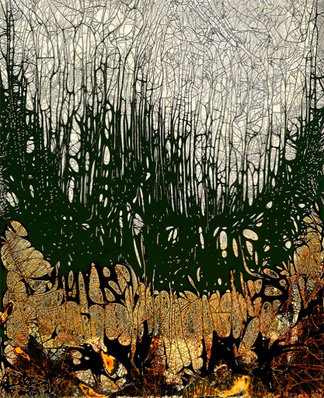
Nolan Preece is giving us more of what we want for the fall season to set us thinking about the natural environment - more chemigrams.  His second show at the Wickiser Gallery in New York, ten beautiful 16x20" prints on Epson Velvet, closed a few weeks ago, just as a new one was opening a thousand miles away at the Southeast Museum of Photography in Daytona Beach, Florida (October 9 - November 24).  It helps to have frequent flyer miles to keep up with him.  We described in previous posts how his work in recent years has shifted from fearless displays of pure darkroom savvy and abandon (www.nolanpreece.com) to a thoughtful treatment of the high desert of Nevada where he lives and which he cares most passionately about, along the eastern slope of the Sierra Nevada range.  No one I know of has been working in chemigrams longer, or more assiduously and uninterruptedly, than Nolan, and it shows in the refinement of his methods.  Against what we thought were the odds, he has brought chemigrams to bear on ecologic concerns: very few other chemigramists have dared undertake such an effort and none of those few have come near to achieving Nolan's success, or his drama.  He has made this ground his own.

Preece, Highlands, chemigram, 2017

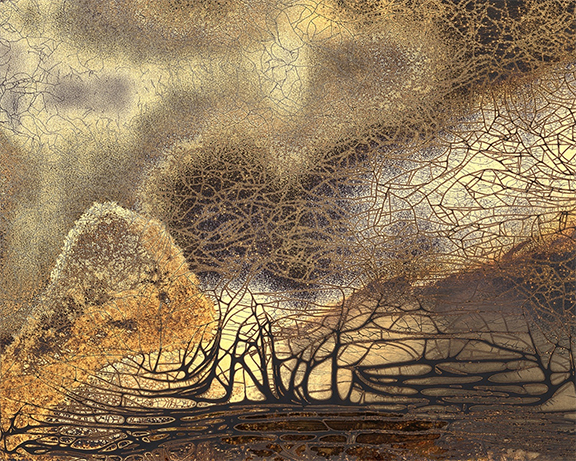
The unfamiliar viewer should not confuse these images with guidebook pictures.  They are the opposite, they are not landscapes but dreams of landscapes, nightmares of landscapes, hallucinations, double-takes, and riffs.  They are emotional above all.  Nolan, who sees the future, is working under the duress of his knowledge.  If you've never seen an emotional chemigram you should look at Highlands, or Mesa - although to be fair we must make exception for Nikolova's powerful work in this regard as well.

Preece, Arroyo, chemigram, 2017

Preece, Cascade, chemigram, 2016

In vain do we seek human presence here, in these canyons and arroyos, so bleak yet so beautifully detailed, but then we realize the enormity of the geologic forces shaping what Nolan has given us.  Men would be nothing, they have no place in it.  Understanding that may lead us to a kind of reverence, if we let it.


Preece, Sierra #2, chemigram, 2016


If you press me for my favorite, I will go with the one below.  Rich in almost boundless mystery, it still has time to leave a wisp of dark mauve in the upper slopes, if slopes they are, as a sign of hope or prophesy, pointing to eons beyond all knowing.


Preece, Peaks, chemigram, 2017


Saturday, April 8, 2017

Nolan Preece goes on national tour


Preece, High Tide, 16x20", 2016

Nolan Preece's chemigrams have acquired a new look in the past couple of years, and if you haven't been paying close attention it's time you did because they are as beautiful as they are accomplished.  We first noticed his explorations into landscape in his show at the Wickiser Gallery in 2016, and this penchant is now on full display at the New York Hall of Science in a sweeping exhibit of 30 works which runs until May 21 before continuing on a national tour.

So what is new?  Well, in a way everything.  First, he has succeeded in achieving a consistency of theme that had eluded him earlier as he pursued the many delights of the darkroom.  He has managed to mesh his newfound ecological focus with a quietly balanced imagery and a more sober palette.  Gone, for now at least, are the flashy, often wanton displays of pyrotechnics that made him a revered master in both the cameraless community and among surrealists but probably cost him points with gallerists and critics.  His long career as ecologist, teacher, backpacker, and picture-framer in the High Sierra desert of Nevada has closed on him and grown its way into his art: he has begun to feel his responsibilities and they are heavy.  In the best sense his present production is a work of engagement and resolution.

So if you can't get out immediately to Queens to see it at the NYHS, we'll try to satisfy you with a few of these superb pictures.  Here goes.

Preece, In The Thicket, 20x16", 2016


Preece, Summit, 16x20", 2016


Preece, Cavern, 16x24", 2016


Preece, Riparian, 16x16", 2016

Preece, At Forest's Edge, 16x20", 2016

Preece, Woodland, 20x16", 2016

The prints are taken from the original chemigram plates as archival pigment prints on either Epson Velvet or Epson Exhibition paper in editions of 10, using the K3 inkset.  The tour will make stops, substantially unchanged, in Gadsen, AL, Anderson, IN, Elko, NV, and Macon, GA, among other destinations.  For further information contact Nolan Preece directly through his website.


Thursday, October 13, 2016

All-silver excitement in Virginia City


Jeanne Chambers, 2016

High in the scrub desert above the Truckee River basin, the old silver mining town of Virginia City, Nevada, was already a legend in the 19th century when fortunes could be made there overnight, then squandered by daybreak in the saloons of C Street.  In a way, not much has changed except that fortunes today are made only in selected of salts of silver, those famously light-sensitive ones - silver bromide and silver chloride - couched in the emulsion of photographic paper.  You dig out the pure stuff not in rocky red igneous earth as in the wild west days but in darkroom trays.  Yes, we're back in the wonderful world of chemigrams.

The annual Nolan Preece chemigram workshop, three days and nights at the end of September, was all silver, nothing digital: the tenacious ghosts of Virginia City wouldn't have it any other way.  Ten students gathered from as far away as Massachusetts and California with Nolan at the helm, in the spacious, well-appointed, and, according to some, possibly haunted St Mary's Art Center.

St Mary's Art Center, Virginia City

Virginia City
We could go on - but won't - about the accommodations in this unique building, constructed during the bonanza heyday 150 years ago and now converted to printmaking and photographic residencies.  You gather a sense of it from the size and airiness of the studios.

chemigram workshop at St Mary's, September 2016

We will want rather to get into the work itself. 

Nolan designed a curriculum to cover all bases of the modern chemigram: dip and dunk, soft resists, hard resists, the effects of various polishes and varnishes, hybrid methods, exotic developers and papers and more, much of which has been touched on elsewhere in this blog.  To witness the refreshing variety of chemigramic response he was able to elicit in just three days made us think of one of the big differences between chemigrams (and other contemporary cameraless procedures) and the methods of craft photography often presented under the label of alt-photography - and that is that once you have a fundamental understanding of where the process is going, you can, in fact you must, sooner or later, break the rules you've just been taught in order to make your own artistic statement.  And that is because it is an art and not a craft: fidelity to rules will lead only to rote applications, to trite expression.  The goal is to overcome that.

Remarkably, in this workshop we already see signs of a stirring in that direction, a pushing at the boundaries.

Mike Clasen, 2016

Nancy Raven, 2016

Greg Albertson, 2016

Debbie Wolff, 2016


Diane Kaye, 2016


Vanessa Stephens, 2016


Susan Watson, 2016


Piera Bernard, 2016


David Laws, 2016


On a technical note, many of the papers provided in the workshop were expired - Kodak, Forte, Luminos, Agfa, Azo - and purposely so, as this is known to be a productive path to follow in chemigrams.  Everyone was encouraged to explore the ways these handled and colored, and to discover the paper's individual signature.

The work turned in by these workshop participants is of a high order indeed, and I believe many veteran chemigramists will come away impressed by it.   Let us hope they continue, for this is just the beginning, not the end.  Each of these artists has taken steps that will become more momentous the further they go, toward an emergent vision, toward something which today they only dimly see but which will unfold as they develop and as the monotonies of the everyday recede.  They arrived with imagination, and now they have the tools to nourish it as well.

If you have questions on particular methods, you may contact Nolan through his website www.nolanpreece.com.

Nolan will have a solo show at Missouri State University's Brick City Gallery, Springfield, January 24 - February 22, 2017, and a two-person show at The Loft at Liz's, Los Angeles, February 18 - March 20, 2017.



Monday, June 6, 2016

Preece at Wickiser Gallery


Preece, Woodland, 2014

Nolan Preece continues the sequence of interpretive landscapes that we first saw in his piece at Soho Photo last fall, this time at the Wickiser Gallery on 11th Avenue in New York where he comfortably shares the spotlight with four other photographers, each bending the rules of photographic art in their own way.

Preece however goes beyond the facile jockeying of pictorial motifs so often encountered in abstract photography, and indeed such as even seen in some of his own early works from the 80s and 90s.  With these pictures, evidently his mature style, he has found a way to turn his chemigramic language around and redirect it to concrete issues of ecology.  Somehow - you have to stare at these pictures for while for the sensation to grip you, but it will - he manages to draw the viewer into a ragged, moon-struck environment at a level that is close to the ground; we feel the way a small breathing creature must feel, a bird darting in the brush, a small snake, a muskrat, though none are seen; it is a world under our eye but totally alien to our species, devoid of humans.  In this way it becomes uncanny, and this in turn is responsible for its strangely compelling hold on us.  We should get used to it he seems to be saying.

Preece, Valley, 2016
How does he do this?  By his choice of colors for one thing: inverting what we expect in a representation of nature he puts, in the foreground, earth colors, bearers of life and hope (or a chance of hope and maybe life), and dark colors above, the realm of death.  There are no angels here.  It is a primeval scene that could go either way.  Nothing stirs.  It awaits our signal, our consent, perhaps our involvement.  Here's another picture by Nolan:

Preece, In the Grove, 2014
It is only from the fractured, dessicated bramble in the lower part of the image that providence may come, while the cursed black orb watches from above.  Again, in an apparent homage to Ansel Adams, where 'Chemigram' may be located on the outskirts of Hernandez:

Preece, Moonrise Over Chemigram, 2015
Bright moon of our dreams rising over a stricken earthscape - a remarkable image.  In the years I've been following his work it has only been with this show that his twin passions, darkroom tinkering and recognizing our stewardship of the earth, have come together in an unapologetic fusion that is of the most potent art.  It should be seen.  It runs until June 21 at the Wickiser Gallery.

The prints are enlargements from scanned original plates, i.e. the primary chemigrams on paper, and are available in two different sizes according to taste.  Prices framed range from $1300 to $2500.  The prints are on Epson Exhibition Fiber or Epson Premier Lustre, depending on size and the printer used.  Original plates were either Kodak Polycontrast or Ektalure G.

Nolan's site is www.nolanpreece.com.


Monday, November 30, 2015

Cameraless at Soho Photo


Soho, New York City

Soho Photo, formed nearly half a century ago and still going strong, is a cooperative photo gallery tucked into Lower Manhattan opposite the ultra-hip Roxy Hotel.  Its shows are always of interest, and every year they put on an alternative process exhibition where you can view some of the best in historical methods: tintypes, calotypes, daguerrotypes, cyanotypes, gum bichromates, lumens, and (not so historical) chemigrams.  We went down to inspect the turnout this year and our eye was immediately lured by the cameraless end of the roster, where beautiful and accomplished chemigrams predominated.  Is it my imagination, or has the number of chemigrams represented increased over the years?  As I recollect, a decade ago they didn't even know what a chemigram was -  I phoned them back then and they had to look it up in a dictionary.  This year there were four chemigrams on the walls.  So, at this rate...


First, here is Veronica Hodgkinson with The Grid (2015), looking unselfconsciously minimalist like an early Cordier or, to make the point more emphatic, like a Carl Andre version from 1969 at the Tate in London.

Hodgkinson, The Grid, 2015
Andre, 144 Magnesium Square, 1969

If you love your chemigrams you'll love this one.  Each square seems to be relaxed about where its imagery is heading; nothing's in a hurry.  The chemistry and resist do the work, with Veronica looking on patiently, tweezers in hand, for the right moment to assist or not.  It's the classic look but I never tire of it.  Incidentally, the resist was not what you think: it was sticky labels - Rich will be excited to hear that - so we can assume the whole procedure took relatively little time, start to finish.  The paper was Kodak AZO, single weight, expired 1977, and her chemistry was from Sprint.

Hodgkinson, Losing It, 2015

In a somewhat different vein is Losing It (2015), a glorious, dancing bit of hybrid work, with photogrammed blots of human hair, presumably the artist's, merging with tiny pools of chemigramish material at each station of a balletic space.  It was created on Kodak Polymax II RC paper, expired 2003.

Nolan Preece is seen with The Clearing, a resist-driven piece, the tiny crackles and fissures in the surface amounting to a signature of sorts for the type of acrylic floor wax that he used.  The whole conception is simple and rather effective and quite welcome.

Preece, The Clearing, 2015
 Here's a detail from the lower left of the picture:

Preece, detail


His linework has an almost fractal quality, in that the closer you get the farther you see you must go to get it all.  It is this infinitely self-generating property of chemigrams and their resists that endlessly fascinates.


Eva Nikolova will not be left out, contributing a large paneled work entitled Tributaries (2015) consisting of 12 chemigrams 5x7" each on Dupont Defender Velour Black, expired 1944.


I never quite know how to talk about her work: is it history or geography, vision or curse?  Are these deep placid rivers draining a ravaged landscape to the sea, where it will be cleansed and renewed?  Like so many chemigrams, this one must be seen up close (maybe at 3 inches!), so we will look for clues there.  Especially telling is the deft treatment of her trademark resists - peanut butter, guava paste, marshmellow fluff (see the previous post), but for us they both reveal all and hide everything as quickly.  And like in Preece's work, the closer you get to it the more you realize you don't know anything.  It's that damned fractality of chemigrams that gives us amazing work like this - in part, but the rest is pure Eva.

Nikolova, detail

Nikolova, detail
veronica-hodgkinson.com
nolanpreece.com
evanikolova.com
sohophoto.com

Tuesday, July 7, 2015

For some, the earth is a darkroom tray

Preece, Walker River near Shurtz, NV, Nov. 2014
Those who follow this blog closely know that Nolan Preece is an experimental photographer, an adept of the darkroom in all its dimensions, a zealot for the secrets of the old chemistry.  He has spent a lifetime producing work, mostly cameraless, driven by this, work that is finding itself increasingly praised for its grit, inventiveness, and engagement.  Many examples can be found in these pages, particularly the three-part series in 2011-2012.  But how many of us know him also as a naturalist, an environmentalist, even an activist, in the Great Basin region of his beloved Nevada?  What are the points of contact between his environmental photography, at its grandest scale as seen here, and his abstract and relatively intimate chemigrams?

The truth is, he was an ecologist and surveyor of wildlife before he even thought of plumbing the recesses of nonfigurative photography.  For years, back in the days before computers and GPS, Nolan would trek into the remote badlands of that vast arid region between the Wasatch Mountains in the east and the Sierra Nevada in the west known as the Great Basin, with notebook in hand, recording everything he saw, plants, birds, animals, snakes, lizards, whatever lived or moved.  It was a sagebrush ecology: cold winters, torrid summers, prehistoric lakes with no outlet to the sea.  After a century of overgrazing and misguided water management it had also become a fragile and endangered environment, with ancient habitats dwindling, riparian woodlands eviscerated, riverbeds run dry, but one with a terrible beauty for those sensitive to it.  Nolan was its advocate. 

Preece, Stillwater National Wildlife Refuge, Carson Sink NV 2013

Preece, Quinn River-Black Rock Desert Wilderness, NV 2009
In recent years he has been renting small Cessnas and flying out over the Basin, leaning from the window and taking pictures.  He returns with images that bear witness, that show and document, and they have all the power of the bare unencumbered look - just as a chemigram shows us what has eroded and what remains in the tray, and we just stare at it.  The pictures tell the story.  There is no aesthetic trickery in Nolan's images, no code to decipher, no conceptual agenda: it is as if the earth itself is doing the talking.  Earlier this year he exhibited a large group of these pictures in Carson City, the state capital, and the project continues, just as the problems and concerns raised in it continue.

Preece, Lahontan Dam and Powerstation near Fallon NV, 2014

Preece, Willow Lake, Carson Sink - Stillwater National Wildlife Refuge, NV, 2013


Preece, Quinn River Sink - Black Rock Playa, NV, 2009

These are clearly the shapes and patterns of an overpowering natural world, to which Preece is acutely attuned.  They have resonated over the years in his darkroom work, in his chemigrams and glassprints, and have given it both a clarity and a greater intensity than it would have without it.  Here's a chemigram from 2012, made quite possibly after a flyover of an ancient sink or a parched riverbed:

Preece, Colony Collapse Disorder #2, detail, 2012

For more information on any of this, contact Nolan himself at preecenolan@gmail.com.


Wednesday, July 30, 2014

Preece retrospective at the Nevada Museum of Art


Preece, Unsettled Grid, 2014

This summer the Nevada Museum of Art celebrates forty years of experimental photography by the great darkroom pioneer Nolan Preece with a long-awaited retrospective of his work.  You've seen some of it on this blog, along with his writings, but never together in one space.  Here it is.  Until August 10.

Mounted in spacious quarters in downtown Reno on the eastern slope of the Sierra Nevada Mountains, the show is a revelation of Nolan's journey from early efforts in the glassprint or cliché-verre technique, such as Dancer below, through a more recent, sustained period of chemigrams, some dramatically life-sized.

Preece, Dancer, 2001
Installation view

It's a must-see event, especially if you're a student of analog photographic abstraction, because there's no place else we know of to enjoy such a wealth of invention, of unabashed joy in the making of pictures using just developer and fixer and maybe one or two other odd chemicals lying around the studio - and light and paper.  He's a wizard with materials.  After spending an hour looking at his pictures, you will want to stop by the gift shop, buy supplies and make some yourself.  If only it were that easy.  The good news is that he does offer workshops and you may contact him for details.


Another installation view


Preece, Hole in Zone O, 1989


Preece, Silver Conglomerate, 2012

Rich Turnbull and I flew out for the opening.  It was a beautiful evening, a band played, drinks were served and before long everyone had a chance to file in and pay attention.  A great setting for wonderful art.

Rooftop, at the opening

Nolan's website is www.nolanpreece.com.