Showing posts with label soft resists. Show all posts

Sunday, November 11, 2018

The power of soft resists


Paloma Boyewa-Osborne, untitled chemigram, 2018

Paloma Boyewa-Osborne lives in the Morningside Heights area of Harlem.  She has been painting and drawing since age 3, although none of that work has come down to us.  Her family introduced her to the chemical darkroom a couple of years ago and today, at the advanced age of eleven, she knows her way around it with disarming confidence.  Last week she participated in a chemigram workshop at the International Center of Photography in New York and produced a group of works in soft resists that caught our attention and then some.

A cautionary note: in sharing these, we implicitly reject the antediluvian notion that success in abstract cameraless photography (or of any art) must be linked to physical maturity, which so often is unstated and assumed.  It doesn't.  Paloma is living proof if you needed any, and we won't say anything further about it.  Let's look at what she did, and then let's discover what we can learn from her.

Paloma Boyewa-Osborne, untitled chemigram, 2018

To my eye, the first thing I'm impressed with is her assertive use of space: filling but not crowding it, respecting its margins but not afraid of them.  Too often, if I can speak for the rest of us, we pull back when we arrive at the end of our paper, unsure of how to handle it, or we're embarrassed by it, or we go into a funk.  We truncate, we turn around, we say goodbye.  Paloma never does, or so it seems.

Related to this is her wonderful, unforced sense of composition, of putting things where they absolutely belong.  Haven't we all had moments when, on reflection, our picture would be great if only it were cut off here, or if that part were placed over there?  But the dynamic of the chemigram is one-way and hurtles us in the forward direction only.  You can't erase, you have to live with what you get.  Paloma rides this dynamic with no apparent stress whatsoever.


Paloma Boyewa-Osborne, untitled chemigram, 2018


Paloma Boyewa-Osborne, untitled chemigram, 2018

She is of those who appear to favor the chaos of soft resists, which are so difficult to tame but so rewarding in the end, to the rigor of the knife and of hard resists.  She is well-suited to it, that much is clear.  The soft resist in chemigrams has always been the poor cousin of the hard, and in our workshops often tends to be passed over with little more than tolerance and good humor.  But Paloma, by her example and the tiny corpus of work produced thus far, goes a fair distance to correct this imbalance.  She should be taken seriously, her work should be taken seriously.  Let us hope there will be a lot more of it.


The young artist at the trays.

I asked her what her favorite soft resists were.  Marshmallow fluff and peanut butter, she replied.  Oh, and canola oil cooking spray, but then we ran out of it.  I would have laughed at this a year ago, but no more.  She has taught me something.


Friday, November 13, 2015

A recent chemigram workshop at ICP with Eva Nikolova

figure 1

At the last minute, Rich Turnbull, my usual co-conspirator and fellow chemigram artist, couldn't make it - they needed him at the Metropolitan Museum to lecture on some bizarre topic that he's expert on, or soon would be if you gave him an hour or so with Wikipedia.  Rich is their back-up academic star and they know it, which, if I were less diplomatic, I would call star abuse.  So I had no choice but to turn to Eva Nikolova to fill in for him and what an unexpected surprise that turned out to be, though I'd had inklings of what was going to happen: I'd seen her work in shows around town for several years, her scarred depictions of ruined dream cities made of the most chaste of materials, and had become a big fan.  What I hadn't counted on was how ready she was to communicate her secret processes to the New York public, for that was to come.

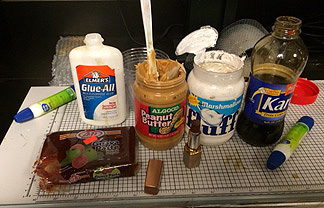
In our little chemigram community, Eva is known for introducing strange new products into the process such as guava paste, marshmellow fluff, peanut butter, lipstick - the list goes crazily on.  If you divide chemigram resists into hard and soft depending on the length of time it takes them to loosen their hold on the photographic paper, the items in Eva's toolbox are all soft resists, which can be used separately or together with 'traditional' soft resists like PVA glue (Elmer's glue) or Karo syrup.  Some are displayed in figure 2, waiting for students to overcome their uncertainty and try them.  Most definitely, Eva is not a purist.

figure 2

Herewith I give you samples of the work our group turned out by day's end, much of it fascinating, all of it entertaining; space limits me from showing more but I could.  As facilitators and guides in this, our job is to point the students in certain directions, show them established methods, suggest possibilities, and then let them have a go at it.  At first they proceed tentatively, feeling their way along, but soon enough they find the handle, or a handle, and begin to assert themselves.  One of the joys of teaching this is to watch the inventiveness of these encounters, student to photographic paper, with their quirks and the individual trace of their personalities, as they embark into regions not only unknown to them but, we soon realize, oftener than we like to admit, to us as well. 

figure 3


figure 4

Here's one that's as rich in depth as you could want, done with what appears to be a combination of guava paste and peanut butter - correct me, readers, if I've got this wrong.  Any lipstick?

figure 5

There's more.  Figure 6 (fig. 1 and 3 as well) shows the rich dark reds obtainable from certain vintage papers, dating from those golden days before papers got their cadmium reformulated away (see our post on this here), not to speak of other mystery substances.  Taking a page from Alison's notebook, Eva thoughtfully provided us with a bounty of gifts: Kodabromide E4 SW expired 1941, Kodabromide F-1 Glossy DW expired 1967 ("dreamy blues, lavenders, silvery greys" says Eva), Dupont Defender Grade 3 DW expired 1951, and Ilford MG 26K FB Velvet Stipple DW expired 1962.  It makes my eyes misty to think about it.  My contribution was the comparatively prosaic Adorama FB Glossy and Fomatone FB Matt, with odd leftovers of Ilford thrown in.  


figure 6

In figure 7, note the canny use of the remaining hard resist (Golden MSA varnish) as design element on a piece of Ilford FB paper.  Most would have continued until all the resist had lifted - I might have too - but not this artist.  A nice call indeed.


figure 7

Figure 8, below, shows what can be done with PVA glue if the snatch point is carefully calculated - by intuition of course.  If snatch point isn't already a keyword in this blog, let's make it one.  That's the moment, usually quite early in the tray dance if you're using soft resists, when you snatch the paper out of one chemical very quickly and thrust it into another, in order to suddenly arrest the action.  A matter of seconds can make all the difference.  In the lower part of the picture observe the white skid marks from the hydrodynamics of a sudden thrust into developer from a fixer launch.


figure 8

We can learn something from each image we present - each has a tale to tell.  For now, pay particular attention to figure 9, where two thickly slathered arrays of Eva's resists have received the same chemical attacks.

figure 9
In one peanut-butter is the main actor, in the other it's lipstick.  Here's a detail of the upper part:

figure 9, detail

Let's look at more work, picking them almost at random.  Here's a soft-resist I like.

figure 10

And another, with hybrid marks drawn from different traditions.

figure 11

Sometimes, the softest marks are those that stay with you the longest.

figure 12

Participants included Mary Alestra, Michelle Bratsafolis, Carol Chu, Sarah Davis, Mira Dayal, Nadezhda Neusypina, and Kiera Wood.  Hats off to all!

                                                   *  *  *

For those interested, Rich Turnbull is doing a chemigram workshop on November 21 at the Penumbra Foundation, just 8 blocks south of here in midtown Manhattan.

International Center of Photography  
www.icp.org

Eva Nikolova
www.evanikolova.com

Penumbra Foundation
www.penumbrafoundation.org

Douglas Collins

Monday, January 20, 2014

Turnbull in Carmel

Turnbull, Dot Studies I, 2013


Richard Turnbull grew up in a hard-resist world, as anyone who explores his website can verify.  He's gone through a checklist of varnishes, putties and lacquers and mucked up an assassin's satchel of knives, blades and other weapons, all in an effort to harness that wild bronco that is the chemigram.  More often than not he's been successful, but that's not been enough.  His restless spirit has drawn him back to more innocent beginnings, to those first steps in chemigram class where they teach you about soft resists - the glues, the syrups, and the tapes.  A lot of professional chemigramists ignore the soft resists but it is here that, for the time being at least, he has found a home, and where he is producing some amazing art.  Arthur Danto, the late philosopher, said there will be no more linear progress in art as a continuity because we're at the end of it: you do what you want, go where you want to go.  Richard Turnbull is a fine case in point.

Dot Studies I, shown above, was picked by the jury at the prestigious Center for Photographic Art in Carmel, California, to hang in their main hall during the annual show which runs until March 1, 2014.  It's made with dot labels, the stick-on kind, and with tape; Rich roams the streets of New York looking for new kinds of tape and labels since each, he says, has a characteristic stickiness, and an associated chemistry.  Under repeated assaults of fixer and developer the dots and tape eventually detach and lift, leaving behind a signature of the last chemical they were in contact with.  Different materials produce a different randomness and present the artist with different choices of when to block or snatch - technical terms of the chemigram trade that refer to an act which terminates a chemical attack.  He's also drawn to stick-on materials for their ability to generate hard and relatively precise lines which, after a good pummelling by chemicals, become little islets of stability and order in a sea of disorder.  Isn't this the beauty of chemigrams, after all?

Rich will offer a workshop in chemigrams at Manhattan Graphics Center on February 22, 2014.  Plan to be there.  In his spare time he teaches art history at F.I.T. and lectures at the Metropolitan Museum, and is also - this must be a sideline, or is it? - an accomplished cook of south-east Asian cuisine.