Showing posts with label chemigrams. Show all posts

Tuesday, March 13, 2018

Chemigrams in Tuscany


chemigram (as photogravure)

A guest post by Franco Marinai

Chemigrams are images produced on photosensitive material by light and photographic chemicals.  They require no camera, no negative, no enlarger or darkroom.  In fact, you make a chemigram in daylight.  You can make it outdoors in the sun if you like, or in the shade of olive trees.

In Serrazzano, a hilltop village in Tuscany not far from Volterra, I make them in an old stable that we have restored to accommodate a printmaking workshop and a photographic darkroom.  In good weather - and it is often quite good - I work outside, in the courtyard of Villa Beltrami, the manor house, or in the piazza inside the medieval walls.


Serrazzano


the courtyard


the piazza

If we speak of the chemigram as a process, we might say that it is all about the action of photographic chemicals, fixer and developer, on the emulsion of photographic paper - or on photographic film, which I favor in my own work.  It results in a unique artifact that, if successful, yields mesmerizing and otherworldly imagery like no other photographic or alternative photographic process.  You have no doubt had occasion to study chemigrams throughout this blog; if you care to see a few examples of my own work transforming chemigrams to photogravure, click here or here.

The ancient hills around Serrazzano are rich in minerals, and in earlier times provided the semi-precious stones that embellished the furniture of the lavish villas of the Medicis.  Nowadays mining is no longer pursued, but the geological wealth of the region still can be seen in the stones used in all varieties of local construction.  The patterns in them inspire me, and are often reflected in my chemigram images.

local stones

chemigram (as photogravure)


the darkroom

While some have compared a chemigramist to a poet taking risks, tinkering with lines (the dark are developed lines, the light are fixed lines), I like to think that making a chemigram is a performance.  It is a lively performance that features invention and discovery, surprises and screw-ups.  The performer must plan, and also be ready to improvise and deal with chance.  She needs a good dose of luck, a cool head, and the presence of mind to make decisions such as when or if to move the emergent chemigram from one bath to another, or whether to use hot water, or change the temperature of the chemicals or their concentration.

When the performance is over - after a few minutes (rarely), several hours, or even a whole night - the result is a unique object, a chemigram, which is a detailed record of that very same performance.  That's because at close examination a chemigram reveals how it came about.  In fact, with some experience, one can tell which outline came before another or which shape preceded another.  So a chemigram is complete picture of its own history, a remarkable two-dimensional representation of the motion of time.

chemigram (as photogravure)

Time is felt everywhere in Serrazzano, and not only in chemigrams: its quiet, steady passing is present in the very earth, the walls, and the ancient buildings.  Serrazzano is first mentioned in a document from the eleventh century, but its origins go back to Etruscan times more than a thousand years earlier.  After a day spent making chemigrams, I like to relax with a drink on the terrace and idly muse on things, or I may choose to get out and explore the bounty of the region, the profusion of grapes, olives, and mushrooms, in the same way Julius Caesar must have done when his legions marched through here in the first century before Christ, heading towards Gaul.  Did they prepare the way for chemigrams?

the terrace
the olive trees

the sheep

an abandoned olive oil mill

TwoCentsPress - Printmaking in Serrazzano is a project to give fellow artists the opportunity to work and live in an extraordinary setting at a very reasonable price.  The project includes accommodations within the historic castle of Serrazzano and 24/7 access to a workshop fully equipped for all intaglio techniques and a darkroom for B&W and alternative photographic processes.  Set in an unspoiled corner of Tuscany, surrounded by pristine and protected forests, it is the perfect place for an artist to concentrate and recharge.  It will provide you with an exceptional experience that you will treasure and wish to return to time and time again.

Visit us online at www.twocentspress.com or on instagram at twocentspress.  You can reach me directly at info@twocentspress.com.  Ciao!


Saturday, February 24, 2018

Why is Chargesheimer so overlooked?

Chargesheimer, ca. 1948

He clandestinely cut out one of his lungs to avoid having to serve in Hitler's Wehrmacht.  The father, who we know little of, was either a card-carrying Nazi or a Nazi sympathizer, so the young man dumped his given name (Karl-Heinz Hargesheimer), called himself simply Chargesheimer, and left home for good.

By 1942 or 1943 he was studying photography, painting, graphic arts, even set design, at different schools in Cologne, and later in Munich.  Returning to Cologne, he began working the streets, photographing workers in bars, schoolkids kicking a football, lovers in doorways, mothers searching for food, and all the dispossessed and the lost who were trying to regain a foothold in life: it was the end of WW II and Cologne was in ruins.

Chargesheimer, Unter Krahnenbäumen, 1958


Chargesheimer, Im Ruhrgebiet, 1957


Chargesheimer, Kissing Couple, ca. 1950

With his camera it was as if he had uncovered a resilience in his people, and he found a deep joy in documenting it.  This would become the theme of a series of books, reviled at first by the city's elders as 'disrespectful' but later celebrated, that he published in the 1950s: Cologne intime, Unter Krahnenbäumen, Im Ruhrgebiet.  To support himself meanwhile he sold photos to newspapers and ad agencies, took assignments in theater as set designer, and eventually - the curve of his early years is steep - directed productions of Eugene O'Neill, Jean-Paul Sartre, and Max Frisch.

To many people today, Chargesheimer is best remembered for another of his sidelines, portrait photography (didn't he already have enough to do?)   He developed a personal style using low angles, tight close-ups and stark contrast, which had the cumulative effect of transforming his living subjects into icons or masks whose power, sometimes hinted at by just the trace of a smile, was undeniable; by the late 1960s they graced the covers of magazines across Europe.  His portraits of Konrad Adenauer, Romy Schneider, Jean-Paul Belmondo, Louis Armstrong and others remain in the popular mind among his most singular achievements.  Here's one though that will be new to many:

Chargesheimer, Josephine Baker, 1956

He developed another reputation in Cologne as well, this one darker, more destructive: as the irascible rebel, the original bad boy.  With glee he would spit in the face of donors and benefactors as the mood suited him; he loved to shake things up.  His 1956 exposition of portraits of the city's leaders in finance and politics caused an outrage: he purposely neglected to fix the photos and in the course of the show they yellowed and deteriorated.  Another time, at a certain point in the premiere of Luigi Nono's Intolleranza at the Cologne Opera, he suddenly projected giant swastikas and concentration camp pictures onto the backdrop and set off a near riot in the audience.

But in fact, it is his disregard for correctness that leads us to why we're talking about him today.  To back up a bit, as soon as he learned how to take photographs and develop them, the much younger Chargesheimer also began experimenting with breaking the very rules he had learned.  He began making photographs without a camera.  What??  Yes, and he mixed materials of different viscosities with fixer or developer, smeared them on paper or glass, then developed the result.  OMG.  He dripped his chemistry or spun it around or raked it with improvised tools, in a freewheeling manner that owed nothing to anyone.  Stop right here.  Isn't this, in a way, an extension of a very old tradition going back to Talbot in 1835, passing through cliché-verres and glassprints?  Well, you could argue that it is but that's beside the point: he just did what felt natural to him, and he kept pushing it in a direction where one picture led to another and another.  The imagery that emerged was airy, lyrical, full of curves and swirls and streakiness, and it seemed without effort.  It still remains breathtaking.  We could go further: this body of work, made off and on from 1946 to 1950, comprising a few dozen pictures at most, is unique in the history of photography and stands apart from everything else he did before or after.  Let's look at some examples.

Chargesheimer, White, 1948

Chargesheimer, ca. 1948


Chargesheimer, ca. 1948


Chargesheimer, ca. 1948


Chargesheimer, Figurative Composition, 1950

By the end of 1940s the rebirth of German photography was well underway.  Emerging photographers were revisiting the lessons of the Bauhaus, suppressed by Hitler, and studied the teachings of Moholy-Nagy with his doctrine of the primacy of the emulsion ('the essential tool of the photographic process is not the camera, but the photosensitive layer').  Otto Steinert and Heinz Hajek-Halke in 1949 launched a movement that embraced this thinking called Fotoform, which later splintered into groups like Subjective Photography and Concrete Photography (Europeans are good with balkanization), all the while maintaining a nearly absolute commitment to abstract or non-figurative work.  Chargesheimer, keeping to himself, chose his own trajectory but was not immune to the creative currents around him: he participated in the big Photokina show in Cologne in 1950 and again for several years thereafter.  When Steinert invited his young student Pierre Cordier to show what Cordier had dubbed 'chemigrams' at Photokina in 1958, it's safe to assume that Chargesheimer saw them.

While all this was happening, at some point in the mid to late 1950s Chargesheimer's cameraless work changed markedly.  Gone were the bold swoops, the confident strokes, the muscular attitude of the earlier period.  Instead of shouting, they seemed to whisper.  They were small, tentative even.  He gathered this work in a one-off book entitled Lichtgrafik - Monoskripturen, then stopped producing altogether. This image is typical:

Chargesheimer, Lichtgrafik, 1961

To be generous you could call them delicate, and some of you may really like them which is okay, but you don't go to Chargesheimer for delicate and anyway it's not that, it's less.  It's not known what precisely caused this change, whether it was seeing too much Hajek-Halke or whether it was something in his personal life, for he was known to suffer bouts of depression.  Perhaps too, as certain critics have speculated, he could have had a foreboding of his own irrelevance with a younger generation advancing on him.   His street photography changed as well, turner colder, unemotional.  His last book, Köln 5 Uhr 30, with its complete absence of human presence, was received with incomprehension.  For unknown reasons he went to the Berner Oberland in Switzerland and took photographs of basaltic rocks on the Eiger, entranced by their crystalline fractures.  These were the last photographs he made.  On New Year's Eve 1971 he committed suicide.

His grave in the Melaten Cemetery in Cologne was lost for years to overgrowth and neglect and was only rediscovered in the nineties.  Today, a small band of followers gather each May 19, his birthday, to pay tribute.

If you have read this far and want to see more of this essential artist, by all means go the Ludwig Museum in Cologne, holders of the major chunk of his work.  In America, the MoMA, the Getty, the Museum of Fine Arts of Houston, and the Harvard Museums all have bits and pieces.  But beware: whether through laziness, inattention, or confusion, many of Chargesheimer's great nonfigurative pictures of the 1940s, the ones we're featuring here and are excited about, are labeled 'chemigram' - a crime perpetuated unfortunately by dealers, auctioneers, curators and museums on both sides of the Atlantic, who don't know what to do with them.  Of course these pictures are not chemigrams at all, as any chemigramist can see.  Perhaps you have to make a chemigram to know what one is.  Besides, the word 'chemigram' didn't exist back then, nor even the idea, the model, of how to do one, go ask Cordier its inventor.  If you want to get all technical you could call them cliché-verres or glassprints and we'd be fine with that.  Personally I prefer to call them cameraless photographs - or just plain pictures on photo emulsion.  You choose.

In any event send your indignation to the appropriate museum, starting with the Getty, as of this writing.


Tuesday, July 5, 2016

Cameraless at Atelier pH7, Brussels

Pierre Cordier & Gundi Falk, Chimigramme 11-6-13 I "Resurgence", 2013
In the quiet, leafy neighborhood of Uccle in Brussels, the quiet gentleman (and maestro) of alternative photography, Roger Kockaerts, has put up a show at Atelier pH7 of alternative work that runs until well into the summer.  If it were only for the van dyck browns, the palladiums, the carbon prints, the bromoils and orotypes and of course the gums, it would be worth seeing, but there is a double reason: a significant part of the show is devoted to cameraless work, in this case the chemigram, and some fascinating and instructive work it is.

The above piece, by the Brussels-based team of Pierre Cordier and Gundi Falk, demonstrates the devotion to exacting conceptions for which they are famous.  Here they compound that practice by using one of their frequent ploys, the hidden puzzle, an audience favorite since time immemorial.  If you stand back and squint real hard you can just make out the letters of the title, R-e-s-u-r-g-e-n-c-e, written left to right and then, as in a boustrophedon, a device popular in ancient Greece, from right to left in the line below and zigzagging back and forth down the picture.  As I say, you have to squint.  Who said boustrophedons were easy!  Yet is the supposed boustrephodon here actually a red herring, a trail leading to a misreading?  It's for you to decide.  Here's a blow-up of the lower left corner, which is elegant fun but unfortunately may not help at all:

detail, Resurgence

In a work like this, planning in advance is essential - everything must be scrupulously mapped out, the incisions, the larger boundaries, the form to be taken by the hidden letters of text, the areas to be masked from chemical assault.  'More Mondrian, less Pollock,' as Pierre has said - a lot more.  The good part is that once set in motion the process more or less proceeds to term on its own, and all the artist has to do is shift the paper from one tray to another.  Imperfections, blips, and other small visitations from the gods of photochemistry, when they happen, are accepted into the picture, indeed they are blessed as emblematic.  But I exaggerate somewhat.

To monitor progress (the new reader should review earlier how-to posts on chemigrams, such as this), the artist may use the thickness of dark and light lines as a measure or trace of ongoing activity, a chronometric record not unlike the growth rings of a tree - an idea which, the more we think of it, may connect chemigrams to the larger saga of natural history and to the seasons of the earth.  If you think this connection far-fetched, we've discussed themes allied to it before in other contexts, for instance in the rate of movement of mackie lines around the equator.  Critics and pundits in the future, if there is a future and there are critics, will want to expound on this.

Another work on view by the same team is 'Musigram', a remarkable piece depicting a fantasy musical score that features a staccato of bips, or congealed clumps of musical notes, against an opulent black.  Don't even think of playing it, it's only for viewing.  One attendee at the opening tried to hum it but failed, complaining he needed a bass line to keep time - or perhaps just a refreshed glass.
Pierre Cordier & Gundi Falk, Chimigramme 11-6-13 I "Musigram", 2013
Here's a closer glimpse into this distinctive work.  The unfathomable, indescribable wonder of the chemigram is on full display.  You can scrapbook this one for study later.

detail, Musigram

Douglas Collins has several chemigrams in the show as well, quite different in design and a far cry from the impeccable work of Cordier & Falk.  All were done earlier this year, mainly in the western Mexican state of Guerrero working under, let's say, simple conditions.  Using Foma FB paper outdoors under a tree, he produced this

Collins, Guerrero series #4, 2016

and this


Collins, Guerrero series #5, 2016
and this

Collins, Guerrero series #11, 2016

The quality of the light and of the water in rural Mexico can be expected to have had an effect, from subtle to determinative: the water was from an ancient well, and bore minerals from deep in the mountainside.  Here's some detail:

detail, Guerrero series #4

and again

detail, Guerrero series #11,
A poet once said that knowledge is like water, 'dark, salt, clear, moving, utterly free.'  These pictures, relaxed and open, suffused with sun, unplanned and unforeseen, seem to partake in the joy of discovering profound secrets when one is least expecting them - or when, rather, one suspects they have been present all along.  

Or, according to Collins, they could express something else entirely, and that's okay with him too.

* * * *

Pierre Cordier and Gundi Falk will be seen at Galerie Volker Diehl (Berlin) in August and at Paris Photo/Scheublein + Bak (Paris/Zurich) in November.  Gundi Falk has a solo show underway at Barbado Gallery (Lisbon).  Collins has work currently on view at IPCNY (New York) and at the Center for Photographic Art (Carmel, California).


Friday, November 13, 2015

A recent chemigram workshop at ICP with Eva Nikolova

figure 1

At the last minute, Rich Turnbull, my usual co-conspirator and fellow chemigram artist, couldn't make it - they needed him at the Metropolitan Museum to lecture on some bizarre topic that he's expert on, or soon would be if you gave him an hour or so with Wikipedia.  Rich is their back-up academic star and they know it, which, if I were less diplomatic, I would call star abuse.  So I had no choice but to turn to Eva Nikolova to fill in for him and what an unexpected surprise that turned out to be, though I'd had inklings of what was going to happen: I'd seen her work in shows around town for several years, her scarred depictions of ruined dream cities made of the most chaste of materials, and had become a big fan.  What I hadn't counted on was how ready she was to communicate her secret processes to the New York public, for that was to come.

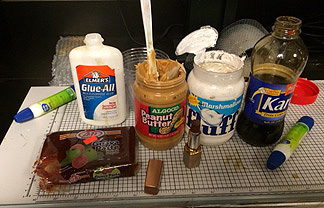
In our little chemigram community, Eva is known for introducing strange new products into the process such as guava paste, marshmellow fluff, peanut butter, lipstick - the list goes crazily on.  If you divide chemigram resists into hard and soft depending on the length of time it takes them to loosen their hold on the photographic paper, the items in Eva's toolbox are all soft resists, which can be used separately or together with 'traditional' soft resists like PVA glue (Elmer's glue) or Karo syrup.  Some are displayed in figure 2, waiting for students to overcome their uncertainty and try them.  Most definitely, Eva is not a purist.

figure 2

Herewith I give you samples of the work our group turned out by day's end, much of it fascinating, all of it entertaining; space limits me from showing more but I could.  As facilitators and guides in this, our job is to point the students in certain directions, show them established methods, suggest possibilities, and then let them have a go at it.  At first they proceed tentatively, feeling their way along, but soon enough they find the handle, or a handle, and begin to assert themselves.  One of the joys of teaching this is to watch the inventiveness of these encounters, student to photographic paper, with their quirks and the individual trace of their personalities, as they embark into regions not only unknown to them but, we soon realize, oftener than we like to admit, to us as well. 

figure 3


figure 4

Here's one that's as rich in depth as you could want, done with what appears to be a combination of guava paste and peanut butter - correct me, readers, if I've got this wrong.  Any lipstick?

figure 5

There's more.  Figure 6 (fig. 1 and 3 as well) shows the rich dark reds obtainable from certain vintage papers, dating from those golden days before papers got their cadmium reformulated away (see our post on this here), not to speak of other mystery substances.  Taking a page from Alison's notebook, Eva thoughtfully provided us with a bounty of gifts: Kodabromide E4 SW expired 1941, Kodabromide F-1 Glossy DW expired 1967 ("dreamy blues, lavenders, silvery greys" says Eva), Dupont Defender Grade 3 DW expired 1951, and Ilford MG 26K FB Velvet Stipple DW expired 1962.  It makes my eyes misty to think about it.  My contribution was the comparatively prosaic Adorama FB Glossy and Fomatone FB Matt, with odd leftovers of Ilford thrown in.  


figure 6

In figure 7, note the canny use of the remaining hard resist (Golden MSA varnish) as design element on a piece of Ilford FB paper.  Most would have continued until all the resist had lifted - I might have too - but not this artist.  A nice call indeed.


figure 7

Figure 8, below, shows what can be done with PVA glue if the snatch point is carefully calculated - by intuition of course.  If snatch point isn't already a keyword in this blog, let's make it one.  That's the moment, usually quite early in the tray dance if you're using soft resists, when you snatch the paper out of one chemical very quickly and thrust it into another, in order to suddenly arrest the action.  A matter of seconds can make all the difference.  In the lower part of the picture observe the white skid marks from the hydrodynamics of a sudden thrust into developer from a fixer launch.


figure 8

We can learn something from each image we present - each has a tale to tell.  For now, pay particular attention to figure 9, where two thickly slathered arrays of Eva's resists have received the same chemical attacks.

figure 9
In one peanut-butter is the main actor, in the other it's lipstick.  Here's a detail of the upper part:

figure 9, detail

Let's look at more work, picking them almost at random.  Here's a soft-resist I like.

figure 10

And another, with hybrid marks drawn from different traditions.

figure 11

Sometimes, the softest marks are those that stay with you the longest.

figure 12

Participants included Mary Alestra, Michelle Bratsafolis, Carol Chu, Sarah Davis, Mira Dayal, Nadezhda Neusypina, and Kiera Wood.  Hats off to all!

                                                   *  *  *

For those interested, Rich Turnbull is doing a chemigram workshop on November 21 at the Penumbra Foundation, just 8 blocks south of here in midtown Manhattan.

International Center of Photography  
www.icp.org

Eva Nikolova
www.evanikolova.com

Penumbra Foundation
www.penumbrafoundation.org

Douglas Collins

Wednesday, July 30, 2014

Preece retrospective at the Nevada Museum of Art


Preece, Unsettled Grid, 2014

This summer the Nevada Museum of Art celebrates forty years of experimental photography by the great darkroom pioneer Nolan Preece with a long-awaited retrospective of his work.  You've seen some of it on this blog, along with his writings, but never together in one space.  Here it is.  Until August 10.

Mounted in spacious quarters in downtown Reno on the eastern slope of the Sierra Nevada Mountains, the show is a revelation of Nolan's journey from early efforts in the glassprint or cliché-verre technique, such as Dancer below, through a more recent, sustained period of chemigrams, some dramatically life-sized.

Preece, Dancer, 2001
Installation view

It's a must-see event, especially if you're a student of analog photographic abstraction, because there's no place else we know of to enjoy such a wealth of invention, of unabashed joy in the making of pictures using just developer and fixer and maybe one or two other odd chemicals lying around the studio - and light and paper.  He's a wizard with materials.  After spending an hour looking at his pictures, you will want to stop by the gift shop, buy supplies and make some yourself.  If only it were that easy.  The good news is that he does offer workshops and you may contact him for details.


Another installation view


Preece, Hole in Zone O, 1989


Preece, Silver Conglomerate, 2012

Rich Turnbull and I flew out for the opening.  It was a beautiful evening, a band played, drinks were served and before long everyone had a chance to file in and pay attention.  A great setting for wonderful art.

Rooftop, at the opening

Nolan's website is www.nolanpreece.com.