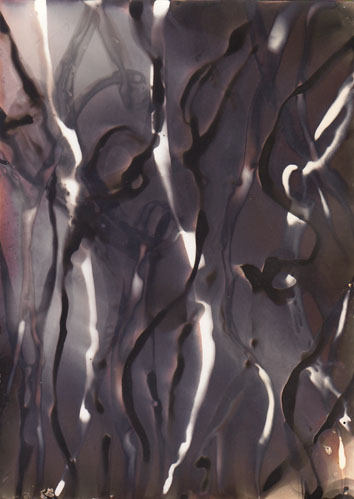
Showing posts with label glassprints. Show all posts

Saturday, February 24, 2018

Why is Chargesheimer so overlooked?

Chargesheimer, ca. 1948

He clandestinely cut out one of his lungs to avoid having to serve in Hitler's Wehrmacht.  The father, who we know little of, was either a card-carrying Nazi or a Nazi sympathizer, so the young man dumped his given name (Karl-Heinz Hargesheimer), called himself simply Chargesheimer, and left home for good.

By 1942 or 1943 he was studying photography, painting, graphic arts, even set design, at different schools in Cologne, and later in Munich.  Returning to Cologne, he began working the streets, photographing workers in bars, schoolkids kicking a football, lovers in doorways, mothers searching for food, and all the dispossessed and the lost who were trying to regain a foothold in life: it was the end of WW II and Cologne was in ruins.

Chargesheimer, Unter Krahnenbäumen, 1958


Chargesheimer, Im Ruhrgebiet, 1957


Chargesheimer, Kissing Couple, ca. 1950

With his camera it was as if he had uncovered a resilience in his people, and he found a deep joy in documenting it.  This would become the theme of a series of books, reviled at first by the city's elders as 'disrespectful' but later celebrated, that he published in the 1950s: Cologne intime, Unter Krahnenbäumen, Im Ruhrgebiet.  To support himself meanwhile he sold photos to newspapers and ad agencies, took assignments in theater as set designer, and eventually - the curve of his early years is steep - directed productions of Eugene O'Neill, Jean-Paul Sartre, and Max Frisch.

To many people today, Chargesheimer is best remembered for another of his sidelines, portrait photography (didn't he already have enough to do?)   He developed a personal style using low angles, tight close-ups and stark contrast, which had the cumulative effect of transforming his living subjects into icons or masks whose power, sometimes hinted at by just the trace of a smile, was undeniable; by the late 1960s they graced the covers of magazines across Europe.  His portraits of Konrad Adenauer, Romy Schneider, Jean-Paul Belmondo, Louis Armstrong and others remain in the popular mind among his most singular achievements.  Here's one though that will be new to many:

Chargesheimer, Josephine Baker, 1956

He developed another reputation in Cologne as well, this one darker, more destructive: as the irascible rebel, the original bad boy.  With glee he would spit in the face of donors and benefactors as the mood suited him; he loved to shake things up.  His 1956 exposition of portraits of the city's leaders in finance and politics caused an outrage: he purposely neglected to fix the photos and in the course of the show they yellowed and deteriorated.  Another time, at a certain point in the premiere of Luigi Nono's Intolleranza at the Cologne Opera, he suddenly projected giant swastikas and concentration camp pictures onto the backdrop and set off a near riot in the audience.

But in fact, it is his disregard for correctness that leads us to why we're talking about him today.  To back up a bit, as soon as he learned how to take photographs and develop them, the much younger Chargesheimer also began experimenting with breaking the very rules he had learned.  He began making photographs without a camera.  What??  Yes, and he mixed materials of different viscosities with fixer or developer, smeared them on paper or glass, then developed the result.  OMG.  He dripped his chemistry or spun it around or raked it with improvised tools, in a freewheeling manner that owed nothing to anyone.  Stop right here.  Isn't this, in a way, an extension of a very old tradition going back to Talbot in 1835, passing through cliché-verres and glassprints?  Well, you could argue that it is but that's beside the point: he just did what felt natural to him, and he kept pushing it in a direction where one picture led to another and another.  The imagery that emerged was airy, lyrical, full of curves and swirls and streakiness, and it seemed without effort.  It still remains breathtaking.  We could go further: this body of work, made off and on from 1946 to 1950, comprising a few dozen pictures at most, is unique in the history of photography and stands apart from everything else he did before or after.  Let's look at some examples.

Chargesheimer, White, 1948

Chargesheimer, ca. 1948


Chargesheimer, ca. 1948


Chargesheimer, ca. 1948


Chargesheimer, Figurative Composition, 1950

By the end of 1940s the rebirth of German photography was well underway.  Emerging photographers were revisiting the lessons of the Bauhaus, suppressed by Hitler, and studied the teachings of Moholy-Nagy with his doctrine of the primacy of the emulsion ('the essential tool of the photographic process is not the camera, but the photosensitive layer').  Otto Steinert and Heinz Hajek-Halke in 1949 launched a movement that embraced this thinking called Fotoform, which later splintered into groups like Subjective Photography and Concrete Photography (Europeans are good with balkanization), all the while maintaining a nearly absolute commitment to abstract or non-figurative work.  Chargesheimer, keeping to himself, chose his own trajectory but was not immune to the creative currents around him: he participated in the big Photokina show in Cologne in 1950 and again for several years thereafter.  When Steinert invited his young student Pierre Cordier to show what Cordier had dubbed 'chemigrams' at Photokina in 1958, it's safe to assume that Chargesheimer saw them.

While all this was happening, at some point in the mid to late 1950s Chargesheimer's cameraless work changed markedly.  Gone were the bold swoops, the confident strokes, the muscular attitude of the earlier period.  Instead of shouting, they seemed to whisper.  They were small, tentative even.  He gathered this work in a one-off book entitled Lichtgrafik - Monoskripturen, then stopped producing altogether. This image is typical:

Chargesheimer, Lichtgrafik, 1961

To be generous you could call them delicate, and some of you may really like them which is okay, but you don't go to Chargesheimer for delicate and anyway it's not that, it's less.  It's not known what precisely caused this change, whether it was seeing too much Hajek-Halke or whether it was something in his personal life, for he was known to suffer bouts of depression.  Perhaps too, as certain critics have speculated, he could have had a foreboding of his own irrelevance with a younger generation advancing on him.   His street photography changed as well, turner colder, unemotional.  His last book, Köln 5 Uhr 30, with its complete absence of human presence, was received with incomprehension.  For unknown reasons he went to the Berner Oberland in Switzerland and took photographs of basaltic rocks on the Eiger, entranced by their crystalline fractures.  These were the last photographs he made.  On New Year's Eve 1971 he committed suicide.

His grave in the Melaten Cemetery in Cologne was lost for years to overgrowth and neglect and was only rediscovered in the nineties.  Today, a small band of followers gather each May 19, his birthday, to pay tribute.

If you have read this far and want to see more of this essential artist, by all means go the Ludwig Museum in Cologne, holders of the major chunk of his work.  In America, the MoMA, the Getty, the Museum of Fine Arts of Houston, and the Harvard Museums all have bits and pieces.  But beware: whether through laziness, inattention, or confusion, many of Chargesheimer's great nonfigurative pictures of the 1940s, the ones we're featuring here and are excited about, are labeled 'chemigram' - a crime perpetuated unfortunately by dealers, auctioneers, curators and museums on both sides of the Atlantic, who don't know what to do with them.  Of course these pictures are not chemigrams at all, as any chemigramist can see.  Perhaps you have to make a chemigram to know what one is.  Besides, the word 'chemigram' didn't exist back then, nor even the idea, the model, of how to do one, go ask Cordier its inventor.  If you want to get all technical you could call them cliché-verres or glassprints and we'd be fine with that.  Personally I prefer to call them cameraless photographs - or just plain pictures on photo emulsion.  You choose.

In any event send your indignation to the appropriate museum, starting with the Getty, as of this writing.


Tuesday, February 24, 2015

A look into Martha Casanave's world

Casanave, untitled, 2012
Martha's been using a camera for fifty years - for teaching, for portraiture, for staged photography, for essays on artists and writers of the former Soviet Union, the list goes on.  Another equally important part of her work during this period has involved specialized cameras: pinholes, large format cameras, nineteenth century contraptions, wherever her heart directs her.  To my mind Martha's finest book remains the amazing pinhole odyssey entitled Explorations Along an Imaginary Coastline, which is essential reading. 

But at times she dispenses with the camera altogether and creates pictures which readers of this blog are familiar with, if not practitioners themselves: lumens, glassprints (Martha sticks by the term cliché-verre and we'll follow her on this), and chemigrams.  Today we want to look at a group of her cliché-verres from 2012, but first we must set the stage.

Casanave, untitled, 2012

Casanave, untitled, 2012
Let's step back and see how we got here.  W. H. Fox Talbot, around 1835, made a few drawings by setting botanical materials on glass plates.  He wanted to see if he could print these images onto paper sensitized with a coating of silver salts.  He could.  Since sunlight was the driving force, he called them 'photogenic drawings' or drawings arising from light.  A few months after he got around to announcing this feat, in 1839, three Englishmen, apparently etchers or engravers, applied for a patent on a process to make a 'glass print' by drawing with etching needles on sooted glass and printing it on sensitized paper.  It was an improvement on Talbot and a legal tussle may have ensued over the rights, we don't know for sure.  What we do know is that the process was never commercialized, and quietly died.  The three Englishmen returned to their etching.

Across the Channel, a Frenchman by the name of Adalbert Cuvelier, an amateur painter and skilled photographer (photography was booming by the 1850s), invented basically the same process in 1853 and called it cliché-verre (who knew it was a zombie process?)  He lived in a rural area and had a friend nearby who was a painter too and loved to paint landscapes.  His name was Jean-Baptiste-Camille Corot.  Corot wanted to learn this new technology, seeing in it a way to do quick sketches from nature which later could be printed, then recast as paintings: a transfer process basically.  Cuvelier was happy to show it to him, and he showed it as well to Corot's circle of painter and printmaker friends - Millet, Delacroix, Rousseau and others - who had begun leaving Paris for the more aesthetically pleasing countryside and forests of Barbizon, south of Arras where Cuvelier lived.  Soon the forests were teeming with artists carrying around sooted glass plates, scouting for scenic views, idyllic streams, stoic peasants.  We are in the heyday of cliché-verre, roughly from 1860 to 1875.  Incredibly, many of these glass plates survive today and can still be contact-printed.
Corot, Souvenir d'Ostie, cliché-verre, 1855


Casanave, untitled, 2012
A rapid succession of technological breakthroughs brought this period to a close, along with possibly - we speculate - a certain ennui of the forests and a yearning for the café life of Paris.  First, gelatin dry-plate photography was invented in 1871 to supplant the older, cumbersome, wet-plate process; George Eastman established a company to exploit it, and it now became much easier to photograph a landscape instead of painstakingly drawing it on a plate.  Cameras themselves became smaller, cheaper and simpler.  Eastman introduced photographic film, and in 1888 a small portable camera, the Kodak; a more revolutionary technology for the general public was not seen until Steve Jobs' iPhone more than a century later.  Cliché-verres by now, amazingly, were soon a relic.

Casanave, untitled, 2012
For the next hundred years and merging with our times, most of the history of cliché-verre has been one of scarcely more than flirtation and curiosity, associated occasionally with hot-button names like Klee, Picasso, Man Ray etc, but with no enduring commitment from anyone.  Each dabbled, did one or two, and moved on.  Roland Barthes discusses some of the reasons in his book The Neutral: Lecture Course at the Collège de France (1977-78) but I warn you if you go there it's buried deeply.  However, as in all things there are exceptions.  I have my favorites among the modern or modernish cliché-verre artists and I return to their work often: I find it passionate and overlooked.  The list must include Hajek-Halke and Chargesheimer in postwar Germany and Aris Koutroulis and Abelardo Morell in America, the latter two both discussed elsewhere on this blog.  (Two other Americans often cited, Henry Holmes Smith and Frederick Sommer, I will pass over in strict silence.)

And then there is Martha Casanave.

What moving, mysterious, wonderful pictures these are.  They wake you up, you who've been sleepwalking through the galleries of contemporary photography.  They lie well beyond representation, even beyond structure, but not beyond poetry.  They are calm, profound, and intricately rational like a microscope slide of a human cell, but a cell no one has ever seen before.  How does she manage to pull it off?

She switches from poetry to prose to help us understand.  "I smoke pieces of glass with a candle.  You can do varying densities of smoke, and varying shapes, depending on how you hold the glass.  Then I drop alcohol on it.  I sometimes use just water.  No predicting how it will look of course.  If I don't like it, I just wash it off and start again.  I don't save any of these 'negatives'.  I make 8x10" prints in the darkroom.  I scan some, and make big digital prints."

Casanave, untitled, 2012
Corot would have understood her, if you take out the digital.  The two of them could have smoked their glass over the same candle.

Her website is www.marthacasanave.com


Wednesday, July 30, 2014

Preece retrospective at the Nevada Museum of Art


Preece, Unsettled Grid, 2014

This summer the Nevada Museum of Art celebrates forty years of experimental photography by the great darkroom pioneer Nolan Preece with a long-awaited retrospective of his work.  You've seen some of it on this blog, along with his writings, but never together in one space.  Here it is.  Until August 10.

Mounted in spacious quarters in downtown Reno on the eastern slope of the Sierra Nevada Mountains, the show is a revelation of Nolan's journey from early efforts in the glassprint or cliché-verre technique, such as Dancer below, through a more recent, sustained period of chemigrams, some dramatically life-sized.

Preece, Dancer, 2001
Installation view

It's a must-see event, especially if you're a student of analog photographic abstraction, because there's no place else we know of to enjoy such a wealth of invention, of unabashed joy in the making of pictures using just developer and fixer and maybe one or two other odd chemicals lying around the studio - and light and paper.  He's a wizard with materials.  After spending an hour looking at his pictures, you will want to stop by the gift shop, buy supplies and make some yourself.  If only it were that easy.  The good news is that he does offer workshops and you may contact him for details.


Another installation view


Preece, Hole in Zone O, 1989


Preece, Silver Conglomerate, 2012

Rich Turnbull and I flew out for the opening.  It was a beautiful evening, a band played, drinks were served and before long everyone had a chance to file in and pay attention.  A great setting for wonderful art.

Rooftop, at the opening

Nolan's website is www.nolanpreece.com.


Friday, December 2, 2011

Nolan Preece talks about his work - part I

(We invited the Nevada-based photographer to discuss his artistic odyssey.  This is the first of several parts.  His website is www.nolanpreece.com. - DC)

Preece, Nolangram #017 (choir), 2001
Let's start off by talking about the cliché-verre pieces from the late 1970s.  It seems I've always had two sides to my art.  I was trained in the Ansel Adams tradition of the fine print and the zone system at Utah State University.  I took a hard core, boot camp zone system class from my favorite photo professor, A.J. Meek.  Ansel Adams, Ruth Bernard, Al Weber, Imogen Cunningham, Jerry Uelsmann and other west coast photographers would frequent our campus giving workshops, lectures, exhibitions and critiques (late 1960s to early 1980s).  I didn't realize what a wonderful experience this was at the time.

Winters were so cold in Cache Valley, where Utah State is situated, with subzero temps for weeks at a time, that my camera gear wouldn't even function outdoors where I wanted to work.  I began to play with chemistry in the darkroom during those cold winter months.  When I went to work on my MFA, I broke with tradition and decided to do my thesis on the "Sabattier Effect."  My second emphasis was printmaking so I have a variety of solvents around the house.  I had researched what Henry Holmes Smith, Frederick Sommer, Francis Bruguiere, Man Ray and Laszlo Moholy-Nagy had done.  I became interested in the effects of soot on glass simply because it could be put in an enlarger and printed as a negative.  I accidentally dribbled some of the kerosene from the lamp I was using to soot the glass and WOW the most beautiful aray of patterns and 3D-looking landscapes unfold before my eyes.  I immediately started trying every solvent I had, finally settling on mineral spirits as the best and cleanest to the image.  I solarized some of the best "glassprints" and published them in my thesis in 1980.  There are two drawbacks to these clichés-verre: 1) When the solvent is applied, it breaks off bits and pieces of soot, sometimes leaving a matrix that has spots that are difficult to remove from the print.  These days, the matrix can be scanned and cleaned up with the healing brush and clone stamp tools in Photoshop.  2) Many attempts need to be made before coming up with a stunner - you generate a lot of rejects.

I've had a few arguments with photographers about the merits of such work along the lines of: is it really photography without a camera involved?  Douglas Kent Hall, the well known New Mexico photographer (who hailed from my hometown of Vernal, Utah), told me to "become the maestro, name it, teach it and present it to the world."  So I jokingly started calling them "Nolangrams."  We traded prints in 2000, not long before he passed away.

Working in isolation has, in some ways, been a benefit.  Not that I haven't been influenced by others but you get so you draw on something deep inside that starts to surface as your own self expression when you're just working by yourself.

So here I give you a sampling of Nolangrams - or clichés-verre if you prefer, or glassprints.  All are selenium-toned gelatin silver prints from a cliché-verre matrix of sooted glass, printed on Forte Warm Tone paper.

Next time we'll talk about my chemigrams, which have had a different history.

Preece, Nolangram #000(legs), 1979

Preece, Nolangram #026(rolling), 2001

Tuesday, May 3, 2011

Glassprints and chemigrams from the 2011 workshop

During the month of May, Manhattan Graphics is hosting an exhibit that celebrates student work from the most recent workshop in glassprints and chemigrams.  You should see it - much of it is very inspired, even unanticipated.  Each year the emphasis shifts a bit in the workshop, reflecting the makeup of the new student group as well as fresh approaches to the teaching of the material, including reworked views of

Kathleen Adams, chemigram


David Thomas, glassprint
 

what that material should be. This year saw, on the glassprint side, a loosening of old restrictions as to what a glassprint represents.  Gone are the fusty rules about carefully mimicking, in brushed ink or smudged marker, a genre scene on acetate.  No landscapes are found here, no vases of flowers on tables with hunting horns.  I used to think that was good strong medicine but it seems the patient is cured.  Instead, we found greater freedom than expected with gobos (Andrea Matura) and scrims (David Thomas), sandwich compositions (Thomas again) and paper negatives (Matura again).  In chemigrams we did some of the usual dip n' dunk, spritzing on the hydroxide and the solvent, but we also got serious about hard resists, and many students went into their toolbox for intricate iconography.  The results show.  Paul Kleinman's resist-filled composition is outstanding; Kathleen Adams' flirt with dichroic dangers is a lot of fun too.  Here's more pictures from the show.

Eva Nikolova, chemigram


Paul Kleinman, chemigram


Andrea Matura, glassprint


David Thomas, glassprint


Paul Kleinman, chemigram


David Thomas, glassprint


Andrea Matura, glassprint


Kathleen Adams, chemigram

Saturday, April 23, 2011

Major glassprint show in San Francisco

Practitioners of the ancient arcane art of glassprints, or clichés-verre, can emerge from their darkrooms, squint and celebrate: a significant show of a spectrum of work in this technique has been mounted by the Jenkins Johnson Gallery of San Francisco.  Entitled "Cliché-Verre in the Digital Age" perhaps to dramatize how long it's been since the last such show, it features work by an international cast whose best-known member, to a New York audience, must be Abelardo Morell (see earlier blog post), but there are other fine contributions as well.  Here are three of them:
David Symons, 2009


Fredrik Marsh, 2000-2011


Suzanne Izzo, 2004

In New York we get a smattering of glassprint shows but no one talks about them much.  An exhibit of the Barbizon school clichés at the Peter Freeman, or a show on Roger Catherineau at the Gitterman, Corot and Millet at the Public Library, a few pictures by Man Ray at the Jewish, the annual class show of glassprints at the Manhattan Graphics Center - that's about it unless you expand the definition of what constitutes a glassprint.  Oh, and the Morells at the Benrubi.

With a show like this, much as it's belated and welcomed, one can easily overlook the fact that many artists not normally considered glassprinters (in fact not ever) but instead mere painters (though of some international stature) may glibly draw from the long history of glassprint methods to create works which the art press will later go on to identify as 'hybrid' or 'mixed media'.  Sigmar Polke, Gerhard Richter, Wolfgang Tillmans come immediately to mind, big names all; there are many others.  Just yesterday I saw an Anselm Kiefer at the Morgan Library that will blow your mind, but no mention of glassprint - yet it was.  The present group seems motivated by quite different concerns however, one of the main being their allegiance to photographic process not only as starting point but as the platform on which their final efforts are meant to be judged, and for that they signal by waving the cliché-verre flag.  They're not addressing the history of art with these works, generally: they've given that up, or maybe were never interested in that to begin with.  Maybe they're 'just photographers', whose conversation runs to filters and hydroquinone when they get together.  So soon we start asking how this or that picture is made, what are the steps, the conceits, the tricky sub rosa moves.  In addition to admiring, often - and we can't help ourselves - the arresting visual results.

For those unfamiliar with the scope of glassprint methods this show is a good place to learn, because it illustrates a broad range of technique, and because it's hard for the uninitiated to understand what you can achieve with just photo paper, developer, fixer, and a few household items (for the most part).  Schoolchildren should go - tell your teachers! - as should artists, scientists, collectors (never forget them) and the general public.  Once the surprise wears off, which could take generations, we can get down to accepting glassprint methods in a general approach to art.

Other exhibiting artists not mentioned above include Jo Bradford, Peter Feldstein, Maggie Foskett, Fred Parker, Frank Rossi, Käthe Wenzel and most especially Courtney Johnson, for bringing this show into being.  It runs from April 7 to May 3, 2011.

Wednesday, February 2, 2011

Paul Kleinman enters the darkroom

I've known Paul for just about five years, not long as things go.  He's an upriver neighbor of mine if you stretch it a little, in the Hudson River Valley north of New York.  I didn't know it at first, but he's an old friend of the great etching teacher at Manhattan Graphics, Vijay Kumar.  Occasionally Paul would come around and show me his ink drawings, landscapes mostly, long lonely lines of dim trees and shadowed hills under a deft touch.  They had a sparse poetry, so unlike the grinning, affable man I knew; I liked them enormously. 

To return the favor, I invited him one day into the darkroom to play with photo paper and light.  After trying first this and then that, he began to settle on a halting, inky language of blurred signs, which I took as another way of expressing the loss and longing (if that's fair) implicit in his spare landscapes, another of his voices.  Here are a couple of pictures from that day; whatever their genesis, for me they deliver a nice shot of glassprint charm and tag.

Kleinman, Glassprint, 2010


Kleinman, Glassprint, 2010


Saturday, January 15, 2011

The example of Morell's glassprints

Abelardo Morell works with the light falling through small holes.  His camera obscura pictures of architecture and Italian piazzas are well-known and deservedly so.  He has also explored photograms and other cameraless techniques, and more recently has done some impressive glassprints, or clichés-verre, in his Island of Rota suite.

Morell, Fern Nine, 2009
Seen as contemporary and shown in the best contemporary venues, like the Bonni Benrubi gallery and MoMA, his work none the less draws heavily on classical themes, Anna Atkins, 19th century botanical illustrations, pressings of flowers.  The use of the glassprint method is appropriate because historical, and also because it allows a great piling-up of imagery and flourish: by using multiple plates or by rearranging the plant and ink materials on one plate repeatedly, he transcends mere illustration to give us considerable depth and wonder.  Glassprint results over the past century have been quite divergent; few would see many similarities between the glassprints of Klee, Picasso, Man Ray, Gyorgy Kepes, or Aris Koutroulis, no more than one would find much in common among photographers or painters of the same period.  Morell's glassprints return us to the earlier state.

And yet a modern sensibility still rules.  He scans his prints, retaining the original as digital file, then prints them as much larger archival pigment prints, possibly on an Epson, in limited editions at 24x20" and 40x30", depending on your taste and pocketbook.

Wednesday, December 29, 2010

glassprint & chemigram workshop in NYC starts soon

Collins, Creation of the World, Part 1, 2010

The annual workshop in glassprints and chemigrams will be held earlier than usual this year, on two successive Sundays, January 30 and February 6, 2011 - so this is your chance to reserve a spot.  Contact Manhattan Graphics Center right away if you're interested, by email or phone.  Because part of the instruction takes place in the darkroom, space is quite limited.

chemistry room, MGC

There aren't many places where you can learn these unusual techniques, which lie at the boundary of photography and painting (with a little alchemy thrown in), but one place certainly is MGC in the Soho area of lower Manhattan.  If you're from out of town or abroad and have always dreamed of coming here, let us know and we'll help you find accomodations that suit you.

By the end of the workshop, you'll feel yourself beginning to develop a personal visual language that will lead to a deepened expressiveness, and you'll be given tools to continue your explorations on your own.  Meanwhile, your best work will be featured in a project-space exhibition in April at the center.  So join us next month to embark on this special adventure.

chemigram workspace, MGC